Posts

Coastal Georgia: Hurricane Season and Septic Flood Risk

Coastal Georgia: Hurricane Season and Septic Flood Risk

Quick answer: From Savannah down through Brunswick and St. Marys, coastal Georgia septic systems sit on sandy soil that’s often shallow over a high water table. Hurricanes and tropical storms push that water table up until the field is saturated and can’t absorb effluent, which can force sewage backups into the home and let floodwater into the tank itself. Pump before storm season, stop using the system entirely during active flooding, and expect to rebuild the tank’s bacterial balance afterward.

From Savannah down through Brunswick and St. Marys, coastal Georgia homeowners deal with a septic challenge inland Piedmont properties don’t: a high water table combined with direct hurricane and tropical storm exposure. This post covers why coastal systems fail differently, and what to do before, during, and after a storm.

The High Water Table Problem

Much of coastal Georgia sits on sandy soil, which on its own drains well. But sandy coastal soil is often shallow over a high water table — in some areas just a few feet down, closer to the surface during wet seasons. A drain field needs unsaturated soil beneath it to work; if groundwater rises to meet the field, effluent has nowhere to go regardless of how well the sand itself would otherwise drain.

This is why coastal Georgia permits often require mounded or raised drain field systems, elevating the field above natural grade to keep it clear of the water table for as much of the year as possible.

What Happens During a Hurricane or Tropical Storm

Storm surge and days of sustained rainfall push the water table up rapidly. When the ground becomes fully saturated:

  • The drain field loses all absorption capacity — it’s essentially sitting in water rather than draining into it
  • Wastewater has nowhere to go and can back up into the home through drains and toilets
  • Floodwater can enter the septic tank itself through the lid or vents, diluting and disrupting the bacterial processes that break down solids
  • If the tank floats or shifts (a real risk in saturated, loose soil), inlet and outlet pipes can crack or disconnect entirely
During active flooding: Stop using the system entirely — no flushing, no laundry, no dishwasher — until floodwater has receded and the ground has had time to drain. Continuing to add water when the field is saturated forces backup into the house.

Before Hurricane Season: A Coastal Georgia Checklist

  1. Pump the tank before storm season starts (May–June) — a tank with less accumulated solids has more spare capacity to absorb a surge in use or temporary field failure
  2. Mark the tank lid location — floodwater and debris can bury access points, making emergency pumping or inspection difficult when you need it most
  3. Check that the tank lid is sealed and secured — an unsecured or cracked lid lets floodwater in and can let sewage out
  4. Clear drainage paths around the field — make sure gutters, downspouts, and yard grading direct storm runoff away from the drain field, not toward it

After the Storm: Signs of Damage

Symptom Likely Cause
Sewage backing up indoors Field saturated or tank overwhelmed
Standing water over field for days after rain stops High water table slow to recede
Sunken or shifted ground near tank Possible tank movement or pipe damage
Strong odor after floodwater recedes Tank’s bacterial balance disrupted by flood dilution

Rebuilding the Tank’s Bacterial Balance

Floodwater intrusion dilutes and disrupts the natural bacteria that break down solids in the tank — the system doesn’t just need to physically dry out, it often needs its biology reset too. This is one of the more useful post-storm applications for a concentrated treatment like Septifix: reintroducing active bacterial and enzyme strains to help the tank get back to normal digestion after a flood event, rather than relying on natural bacteria to slowly repopulate on their own.

Read the Full Septifix Review →
Affiliate link — we may earn a commission at no extra cost to you

Frequently Asked Questions

Why do coastal Georgia septic systems fail during hurricanes?
Coastal Georgia sits on sandy soil that drains well on its own, but it’s often shallow over a high water table. Storm surge and sustained rainfall push that water table up rapidly, and once the ground is saturated, the drain field loses all absorption capacity — it’s essentially sitting in water rather than draining into it, which can force sewage back into the home.
Should I use my septic system during a flood?
No. Stop using the system entirely — no flushing, no laundry, no dishwasher — until floodwater has receded and the ground has had time to drain. Adding water while the field is saturated forces backup into the house.
How do I prepare my septic system for hurricane season?
Pump the tank before storm season starts (May-June) so it has spare capacity, mark the tank lid location before floodwater or debris can bury it, check that the lid is sealed and secured so floodwater can’t get in, and make sure gutters and yard grading direct runoff away from the drain field.
Does floodwater damage a septic tank’s bacteria?
Yes. Floodwater intrusion dilutes and disrupts the natural bacteria that break down solids in the tank, so after a flood the system often needs its biology reset, not just time to physically dry out. A concentrated bacterial and enzyme treatment can help reintroduce active strains rather than relying on natural bacteria to slowly repopulate.

This article is for general informational purposes. If you suspect septic damage after flooding, contact a licensed Georgia septic professional before resuming normal water use — some damage requires inspection or repair, not just time. Product results vary by individual system condition and usage. This post contains affiliate links; we may earn a commission if you make a purchase, at no extra cost to you.

Piedmont Clay Soil: Percolation Rates and Drain Field Design in Georgia

Piedmont Clay Soil: Percolation Rates and Drain Field Design in Georgia

Quick answer: If your home sits anywhere in the band from Columbus through Atlanta up to Athens and Gainesville, you’re on Piedmont clay, which routinely perc tests at 45-90+ minutes per inch versus 2-5 minutes for sandy soil. That slow rate can force a drain field 2-3x larger than an identical home would need on sandy soil, and installers compensate with chamber systems, wider shallow trenches, pressure dosing, and larger reserved backup areas.

If your home sits anywhere in the band running from Columbus through Atlanta up to Athens and Gainesville, you’re on Piedmont soil — and if a septic installer has ever mentioned “perc rate” and shaken their head, this is why. This post digs into what percolation actually means, why Piedmont clay scores so poorly, and how drain fields are designed differently here than in sandier states.

What a “Perc Test” Actually Measures

Before any septic system is permitted in Georgia, a percolation test is required. A hole is dug to the depth of the proposed drain field, filled with water, and timed to see how many minutes it takes the water level to drop one inch. Sandy soil might drain in 2–5 minutes per inch. Piedmont red clay routinely comes back at 45–90+ minutes per inch, and in the worst spots, water barely moves at all.

Slow percolation isn’t just an inconvenience for the county inspector — it directly determines how large your drain field needs to be. The slower the perc rate, the more square footage of trench is required to safely absorb the same volume of wastewater.

Why this matters to you: Two identical 3-bedroom homes — one on sandy coastal soil, one on Piedmont clay — can need drain fields that differ in size by 2–3x. If you’re buying land or planning an addition, the perc test result should shape your expectations before you shape your budget.

How Installers Compensate for Clay

Because gravity-fed trench systems struggle in tight clay, Piedmont installers lean on a few adaptations:

  • Chamber systems instead of gravel — plastic chambers create open void space that holds effluent longer, giving clay more time to slowly absorb it
  • Shallow, wider trenches — spreading the field out laterally rather than digging deep, since clay’s absorption capacity is limited regardless of depth
  • Pressure-dosed systems — a pump distributes wastewater evenly across the whole field in timed doses instead of letting it flow to the nearest low point, which helps prevent one section of clay from oversaturating while the rest stays dry
  • Larger reserve areas — Georgia permits typically require a backup drain field site reserved on the property, since clay fields fail and get replaced more often than sandy ones

The Compaction Problem

Clay has a second issue beyond slow percolation: it compacts easily. Heavy equipment, vehicles, or even repeated foot traffic over a drain field can press the clay particles tighter together, reducing what little absorption capacity it had. This is why installers are strict about keeping the drain field area clear of driveways, sheds, pools, and parking — on sandy soil this rule is a guideline; on Piedmont clay it’s closer to a hard requirement.

Signs Your Piedmont Drain Field Is Struggling

Sign What’s Happening Underground
Grass over field greener than rest of yard Effluent nutrients feeding grass near surface
Standing water/mud after rain, slow to dry Clay saturated, no absorption capacity left
Sewage smell outdoors Effluent surfacing rather than draining down
Slow drains indoors with no clear cause Field backing up into tank, tank backing up into pipes

Supporting an Undersized or Aging Clay-Soil System

Not every Piedmont homeowner can afford to re-engineer a drain field. For systems that are functional but working at their limit, reducing the solids load reaching the field matters more here than almost anywhere else — a field with no drainage margin has zero tolerance for extra sludge carryover.

This is the logic behind using a monthly bacterial/enzyme treatment like Septifix: it targets breakdown of the sludge layer inside the tank itself, aiming to keep solids from migrating out to a field that’s already working against dense clay. It’s not a fix for a genuinely undersized system, but for a borderline one, every bit of tank efficiency helps.

Read the Full Septifix Review →
Affiliate link — we may earn a commission at no extra cost to you

Frequently Asked Questions

What is a septic perc test and why does it matter on Piedmont clay?
A percolation test digs a hole to the depth of the proposed drain field, fills it with water, and times how long it takes the water level to drop one inch. Sandy soil might drain in 2-5 minutes per inch; Piedmont red clay routinely comes back at 45-90+ minutes per inch. The slower the perc rate, the larger the drain field must be to safely absorb the same volume of wastewater.
How much bigger is a drain field on Piedmont clay?
Two identical 3-bedroom homes — one on sandy coastal soil, one on Piedmont clay — can need drain fields that differ in size by 2-3x, because clay’s slow absorption rate requires far more square footage of trench to handle the same wastewater volume.
How do installers design septic systems for Piedmont clay?
Common adaptations include chamber systems instead of gravel to hold effluent longer, shallow and wider trenches spread laterally rather than dug deep, pressure-dosed systems that distribute wastewater evenly across the field in timed doses, and larger reserved backup drain field areas, since clay fields fail and get replaced more often than sandy ones.
Why is soil compaction a bigger problem on clay than sandy soil?
Clay compacts easily under heavy equipment, vehicles, or repeated foot traffic, pressing particles tighter together and reducing what little absorption capacity it had. Installers are strict about keeping driveways, sheds, pools, and parking off the drain field area — a guideline on sandy soil, but closer to a hard requirement on Piedmont clay.
More in This Cluster

This article is for general informational purposes. Percolation rates vary by specific lot and should be confirmed by a licensed Georgia septic installer or county health department test. Product results vary by individual system condition and usage. This post contains affiliate links; we may earn a commission if you make a purchase, at no extra cost to you.

Georgia Septic Systems: Red Clay, Heavy Rain, and What It Means for Your Tank

Last updated: September 2026 · Est. reading time: 6 minutes · Pillar page for the Georgia Septic Systems cluster

Georgia Septic Systems: Red Clay, Heavy Rain, and What It Means for Your Tank

Short answer: Georgia’s septic systems split into three regional problems layered on top of some of the heaviest seasonal rainfall in the Southeast (45+ inches a year in many counties): dense red clay in the Piedmont belt running through Atlanta, Athens, and Columbus, where percolation rates of 45–90+ minutes per inch demand oversized drain fields; a high water table along the Coastal Plain around Savannah and Brunswick, where hurricane and tropical storm exposure adds seasonal flood risk on top of slow-draining sandy soil; and shallow soil over bedrock in the North Georgia mountains, where slope and rock — not clay — limit where a system can go. Because clay soil already runs close to its absorption limit statewide, most Georgia installers recommend pumping every 2–3 years rather than the national 3–5 year guidance.

Why Georgia Is a Uniquely Tough State for Septic Systems

Georgia’s geology splits roughly into three bands: the mountainous north, the red-clay Piedmont running through Atlanta and the Midlands, and the sandy Coastal Plain in the south. Each behaves differently underground, but the Piedmont clay belt is where most of the state’s population — and most septic complaints — live.

Red clay is notorious among installers for one reason: it has very low percolation rates. Percolation, or “perc,” is how fast water moves through soil. Clay particles are microscopically small and pack tightly, so instead of draining, wastewater tends to pool at the surface of the drain field trenches. When a system is undersized or aging, this shows up as slow drains indoors and soggy, foul-smelling patches over the drain field outdoors.

Quick check: If your lawn over the drain field is greener and spongier than the rest of your yard — especially after rain — that’s often standing effluent close to the surface, not just good soil. It’s one of the earliest visible warning signs.

The Rainfall Factor

Georgia averages well over 45 inches of rain a year in many counties, with Atlanta and the northern half of the state seeing sharp spring and early-summer downpours. When heavy rain lands on already-saturated clay, the soil’s absorption capacity — already limited — drops to almost nothing. This is when systems that were “fine” all year suddenly back up.

Hurricane remnants and tropical storms tracking up from the Gulf or Atlantic add a second layer of risk for the southern half of the state, saturating ground for days at a time. A septic system that’s borderline in July can fail outright after a wet tropical system in September.

Season What Homeowners Typically Notice
Spring (Mar–May) Slow drains after storms, drain field mushiness
Summer (Jun–Aug) Odors intensify with heat and humidity
Late Summer/Fall Tropical system backups, standing water over field
Winter Fewer symptoms, but ground rarely fully dries in clay areas

The Three Georgia Septic Regions

1. Piedmont Clay — Metro Atlanta, Athens, Columbus

Dense red clay routinely tests at 45–90+ minutes per inch on a percolation test, requiring drain fields 2–3x larger than an identical home on sandy soil, plus chamber systems, pressure dosing, and mandatory backup field reserves.

Read the full guide →

2. Coastal Georgia — Savannah, Brunswick, St. Marys

Sandy soil that would otherwise drain well sits over a high water table just a few feet down, and direct hurricane exposure means storm surge and sustained rainfall can flood a tank’s bacterial colony as well as its drain field.

Read the full guide →

3. North Georgia Mountains — Dahlonega, Blairsville, Ellijay

Only 12–24 inches of usable soil sits over bedrock in much of this region, and slopes of 15–25% or more mean gravity, not clay, is the main design constraint — often requiring contour-following trenches or pump-assisted systems.

Read the full guide →

What This Means for Maintenance

Because red clay soil already runs close to its absorption limit, Georgia septic systems generally need closer attention than the “pump every 3–5 years” rule you’ll see quoted nationally. A few adjustments that matter here:

  • Pump more frequently on clay lots — many Georgia installers recommend every 2–3 years for homes on heavy clay, versus 3–5 elsewhere. Full regional cost breakdown in our Georgia pumping costs guide.
  • Watch water usage after storms — running laundry or long showers during or right after heavy rain gives the drain field no capacity to cope.
  • Keep gutters and grading directing water away from the drain field — extra surface water on top of clay’s poor drainage compounds the problem fast.
  • Support the tank’s biological balance — the bacteria that break down solids are already working against a slower-draining field, so anything that disrupts that balance (harsh chemicals, antibacterial soap in bulk, bleach overuse) hits harder here than in sandy-soil states.

Red flag: Sewage odor indoors combined with gurgling drains after a storm is a sign the field is at or past capacity. This is not a “wait and see” situation — continued use can push effluent to the surface or back into the home. See the full symptom breakdown by region in our Georgia symptoms hub.

Where a Product Like SEPTIFIX Fits In

Because Georgia clay already limits how much margin a drain field has, anything that helps the tank break down solids more completely before effluent reaches the field is worth understanding. SEPTIFIX is a tablet-based septic treatment designed to introduce concentrated bacterial and enzyme strains that target the sludge layer, with the goal of reducing solids buildup between pumpings.

It won’t change your soil type and it isn’t a substitute for pumping — nothing is. But for homeowners trying to stretch the life of a system that’s working against dense clay and heavy rainfall, a monthly tablet is a low-effort way to support what the tank is already trying to do.

Read the Full SEPTIFIX Review →

Frequently Asked Questions

Why is Georgia especially hard on septic systems?

The combination of dense, slow-draining Piedmont clay and some of the heaviest seasonal rainfall in the Southeast (45+ inches annually in many counties) means drain fields have less absorption margin than in most other states, and heavy storms can push a borderline system into failure.

What are the three main Georgia septic regions?

The red-clay Piedmont belt (Atlanta, Athens, Columbus), the sandy but high-water-table Coastal Plain (Savannah, Brunswick), and the shallow, sloped soil of the North Georgia mountains (Dahlonega, Blairsville, Ellijay) — each with a different limiting factor for system design.

How often should a Georgia septic tank be pumped?

National guidance says every 3–5 years, but many Georgia installers recommend every 2–3 years for homes on Piedmont clay, since a field with little drainage margin has less tolerance for excess solids reaching it. Coastal and mountain regions generally fall closer to the 3–4 year range.

Does hurricane season affect Georgia septic systems?

Yes, particularly along the coast. Tropical storms and hurricane remnants can saturate ground for days, temporarily eliminating a drain field’s absorption capacity and, in coastal areas, flooding the tank itself and disrupting its bacterial colony.

Can a septic treatment product fix a Georgia clay-soil system?

No single product changes clay content or replaces pumping. A monthly bacterial treatment like SEPTIFIX can help the tank digest solids more completely before they reach an already-strained drain field, but it supports maintenance — it doesn’t re-engineer a field that’s genuinely undersized.

Explore the Full Cluster

Piedmont Clay Soil

Percolation Rates and Drain Field Design

Read the guide →

Coastal Georgia

Hurricane Season and Septic Flood Risk

Read the guide →

North Georgia Mountains

Rock, Slope, and System Placement

Read the guide →

Georgia Septic Pumping Costs

Regional Pricing Breakdown

Read the guide →

Symptoms Hub

Is Your Georgia Septic System Failing?

Read the guide →

This article is for general informational purposes and reflects typical conditions across Georgia’s soil regions. Always consult a licensed septic professional for an assessment specific to your property. Product results vary by individual system condition and usage.

Affiliate Disclosure: This page contains affiliate links to SEPTIFIX. If you purchase through a link here, we may earn a commission at no extra cost to you. This is independent editorial content — SEPTIFIX is referenced only as a maintenance aid and does not replace required site evaluation, permitting, or drain field engineering.

👤 Reviewed and maintained by the SEPTIFIX Review editorial team, who track state-specific soil, water-table, and regulatory conditions for septic systems across the U.S.

Septic Tank Smells in Florida Heat: 7 Causes and How to Fix Them

Septic Tank Smells in Florida Heat: 7 Causes and How to Fix Them

Quick answer: Florida septic odor gets worse in heat because gases expand and escape faster, warm bacteria produce more hydrogen sulfide, and humidity holds the smell at nose height. The 7 causes, cheapest to most serious: a dried-out drain trap, a blocked vent stack, a full tank overdue for pumping, a weak bacterial colony, wet-season drain field saturation, a failing drain field, and damaged or unsealed components. Most Florida septic smells are solved by the first four.

There’s a particular moment every Florida septic owner knows: you step outside on a 95-degree afternoon, the air is thick, and there it is — that unmistakable rotten-egg smell drifting across the yard. Or worse, it’s inside the house.

Heat makes everything about septic odor worse. Gases expand and escape faster, bacteria produce more hydrogen sulfide in warm tanks, and Florida’s humidity holds the smell at nose height instead of letting it disperse.

Here’s the good news: septic smell is a symptom with a short list of causes, and most of them are cheap to fix. Work through this list in order — it runs from easiest to most serious.

1. A Dried-Out Drain Trap (Indoor Smell, One Room)

Every drain in your house has a U-shaped trap holding water that blocks sewer gas. In a guest bathroom or utility sink that rarely gets used, Florida heat evaporates that water in a couple of weeks — and the smell walks straight in.

Fix: Run water in every rarely-used fixture for a minute. Pour a cup of water into floor drains. If the smell was in one room, this solves it more often than any other cause on this list. Total cost: nothing.

2. A Blocked or Undersized Vent Stack (Indoor or Roof-Level Smell)

Your plumbing vents septic gas through a pipe in the roof. Birds’ nests, leaves, or even a poorly placed extension can block it, forcing gas back through the weakest trap in the house. In summer, downdrafts can also push vent gas down toward patios and pool decks.

Fix: Visually check the roof vent for obstructions. Extending the vent pipe or adding a carbon vent filter (a $30–$60 part) cures most persistent vent odors.

3. A Full Tank (Smell Near the Tank Lids)

Simple maths: when the sludge and scum layers get thick enough, gases have less liquid to pass through and less space to sit in, and every toilet flush pushes a puff of gas out through the lids and vents. If it’s been 4+ years since your last pump-out, this is the likely culprit.

Fix: Book a pump-out ($300–$600 in most of Florida). While the pumper is there, have them check the inlet/outlet baffles and the lid seals — worn lid gaskets are a classic slow leak for odor and cost very little to replace.

4. A Struggling Bacterial Colony (Smell From Tank and Drains, Getting Gradually Worse)

This is the big one in Florida, and the one most articles skip.

A healthy septic tank doesn’t actually smell that bad, because a thriving bacterial colony digests waste efficiently and keeps hydrogen sulfide production low. But Florida households are hard on bacteria: chlorinated pool water backwash, bleach-heavy cleaning against the mold, antibacterial soaps, medications, and wet-season groundwater dilution all thin the colony out. A weak colony digests less, the sludge layer grows anaerobic and sour, and the tank starts producing serious gas.

The tell: the smell builds gradually over weeks, comes from drains and the yard, and often arrives alongside slower drains and gurgling.

Fix: Rebuild the colony. Stop the chemical assault where you can (swap bleach for oxygen-based cleaners, keep pool backwash out of the system entirely), then reseed the tank with a monthly bacteria treatment. This is exactly the job Septifix was designed for — each monthly tablet releases oxygen into the tank and adds 14 strains of aerobic bacteria, which digest waste faster and, crucially for this article, suppress the sulfur-producing anaerobic activity that causes the smell. Users typically report odors fading within days of the first tablet, and at around $9/month it’s the cheapest permanent fix on this list, and the only one that also protects your drain field.

5. Wet-Season Saturation (Yard Smell After Rain)

If the smell appears in the yard mainly after heavy rain, your drain field is telling you it’s saturated — Florida’s high water table rising into the field and pushing gas (and sometimes effluent) to the surface. The smell is the early warning; the soggy grass comes next.

Fix: This one needs its own article, because it’s the most expensive problem on this list if ignored — see Why Florida’s High Water Table Destroys Septic Systems. Short version: cut household water use during wet spells, keep roof runoff away from the field, and keep your tank bacteria strong so no solids reach the struggling field.

6. A Failing Drain Field (Persistent Yard Smell, Lush Stripes of Grass)

If the yard smells in dry weather too, and you can see suspiciously green, spongy stripes over the field, effluent is surfacing because the field can no longer absorb it. This is beyond DIY.

Fix: Call a licensed septic contractor for an inspection. Caught early, some fields can be rested and recovered (sometimes with jetting or aeration); caught late, you’re into repair or replacement territory — $2,000 to $30,000 depending on damage. Either way, faster is cheaper.

7. Damaged or Unsealed Components (Localized, Constant Smell)

Cracked lids, degraded gaskets, a damaged inlet baffle, or an old tank with a corroded top can all leak gas constantly in one spot. Concrete tanks from the 70s and 80s — common across older Florida neighbourhoods — are especially prone.

Fix: Have components checked at your next pump-out. Lid gaskets and risers are cheap; a corroding tank top is something you want to know about before it becomes a safety issue.

The Florida Heat Factor

Whatever the cause, expect it to be worst in the late afternoon during summer, before storms (falling air pressure pulls more gas out of the system), and in still, humid air. If your smell only appears under those conditions and is faint, you’re catching a problem early — which is the best possible time to fix it.

The Bottom Line

Run the checklist in order: traps, vents, pump-out, bacteria, water table, field, components. Most Florida septic smells are cured by the first four — and the fourth one, a rebuilt bacterial colony, is the fix that keeps the smell from ever coming back.

Read Our Full Septifix Review →
Affiliate link — we may earn a commission at no extra cost to you

Frequently Asked Questions

Why does septic smell get worse in Florida heat?
Heat makes septic gas expand and escape faster, warm tank temperatures make bacteria produce more hydrogen sulfide, and Florida’s humidity holds the smell at nose height instead of letting it disperse — so the same underlying issue smells noticeably worse on a 95-degree afternoon than it would in cooler weather.
What’s the most common cause of septic smell in one room of the house?
A dried-out drain trap. The U-shaped trap under a rarely-used sink or floor drain normally holds water that blocks sewer gas, but Florida heat can evaporate that water in a couple of weeks. Running water in the fixture for a minute usually fixes it immediately at no cost.
Why does my septic tank smell even though I pump it regularly?
A weak bacterial colony is often the cause. Chlorinated pool backwash, bleach-heavy cleaners, antibacterial soaps, medications, and wet-season groundwater dilution all thin the bacteria that normally digest waste efficiently and keep hydrogen sulfide low. When the colony weakens, sludge turns anaerobic and sour, and the smell builds gradually across weeks alongside slower drains and gurgling.
Why does my yard smell like sewage after it rains?
This usually signals drain field saturation — Florida’s high water table rising into the field and pushing gas, and sometimes effluent, to the surface. It’s an early warning sign; soggy, spongy grass over the field typically follows if the pattern continues.

This article is for general informational purposes and reflects typical conditions across Florida. Costs are general estimates and vary by provider, property, and site conditions. Always consult a licensed Florida septic professional for site-specific issues. Product results vary by individual system condition and usage. This post contains affiliate links; we may earn a commission if you make a purchase, at no extra cost to you.

Why Florida’s High Water Table Destroys Septic Systems

Why Florida’s High Water Table Destroys Septic Systems (And What To Do)

Quick answer: Across much of Florida the water table sits just a few feet down and rises during wet season, saturating the drain field so effluent can’t filter through dry soil. That saturation reverses flow, floods the tank, and dilutes the bacterial colony that digests solids — so a struggling field also starts receiving undigested waste. The damage compounds year over year until a field that seemed fine suddenly doesn’t recover. The fix: send the field less water, keep its bacteria strong, pump on an aggressive 2-3 year dry-season schedule, and consider a mound system if you’re replacing anyway.

Ask any septic contractor in Florida what kills more systems than anything else and you’ll get the same answer: water from below.

Not what you flush. Not tree roots. Groundwater — sitting so close to the surface in much of Florida that your drain field spends part of every year fighting for its life.

If your drains slow down every summer, your yard smells after rain, or your grass turns swampy over the drain field, this article explains exactly what’s happening under your lawn and what you can actually do about it.

What the Water Table Has to Do With Your Septic System

Your drain field only works if there’s unsaturated soil underneath it. Effluent trickles out of the perforated pipes, filters down through dry soil, and the soil’s bacteria finish cleaning it before it reaches groundwater. Florida rules require a couple of feet of separation between the bottom of your drain field and the seasonal high water table for exactly this reason.

The problem: across huge swathes of Florida, the water table sits just a few feet down — and in the wet season it rises. When groundwater rises into your drain field:

  • Treatment stops. Effluent meets water instead of dry soil. Nothing filters.
  • The field waterlogs. Saturated soil can’t absorb anything, so effluent has nowhere to go.
  • Flow reverses. With the field full, wastewater backs up the line — into the tank, then toward the house.
  • The tank floods. Groundwater can seep into the tank itself, diluting and drowning the bacterial colony that breaks down your solids.

That last point is the one almost nobody talks about, and it’s why water table problems compound. A flooded, diluted tank loses its bacteria. With the bacteria weakened, solids stop breaking down and get pushed out into an already-struggling drain field. The wet season causes the damage; the dead tank makes it permanent.

The Symptoms, Season by Season

Wet season (roughly June–September): slow drains across the whole house, gurgling toilets, sewage smell in the yard, soggy or spongy ground over the field, backups after heavy rain. Many Florida homeowners live with this every single summer and assume it’s normal. It isn’t — it’s a system telling you it’s at capacity.

Dry season: everything seems fine again. This is the trap. The drain field partially recovers, symptoms fade, and the underlying damage — a biomat of escaped solids clogging the field’s soil interface — quietly grows. Each wet season starts a little worse than the last, until one year the field doesn’t recover at all.

A drain field replacement in Florida runs $10,000–$30,000. Most of the ones that fail were killed over several years by exactly this cycle.

What You Can’t Control — and What You Can

You can’t lower Florida’s water table. If your system was built decades ago with less separation than modern rules require, you can’t easily change that either (short of an expensive mound system). But the difference between a system that survives high water and one that dies from it comes down to factors you control completely.

1. Send the drain field less water

A saturated field needs every gallon of relief you can give it:

  • Spread laundry across the week — never five loads on a Saturday
  • Fix running toilets immediately (a single running toilet can dump 200+ gallons a day into your field)
  • Fit low-flow fixtures
  • Route gutters, roof runoff and AC condensate away from the drain field — the field has enough water coming from below

2. Send the drain field cleaner water

This is the big one. A field under water-table stress can just about cope with clean effluent. What it cannot cope with is solids — and solids escape the tank the moment your bacterial colony weakens.

Florida’s wet season attacks the bacteria directly: groundwater infiltration dilutes the tank, heavy household water use flushes it, and the colony crashes right when the drain field is most vulnerable. This is precisely the situation monthly bacteria treatment exists for. A product like Septifix — a slow-dissolving monthly tablet that releases oxygen and reseeds the tank with 14 strains of aerobic bacteria — keeps the colony strong through the wet season, so solids keep breaking down even when the tank is diluted and stressed, at about $9/month against a $20,000 drain field replacement.

3. Pump more often than the national advice says

The standard “every 3–5 years” guidance was not written for high-water-table Florida. If your system floods seasonally, pump toward the aggressive end — every 2–3 years — and schedule it for the dry season, when the pumper can actually inspect the tank properly and the field gets maximum benefit. Never pump a tank while the ground is flooded; an empty tank in saturated soil can literally float out of the ground.

4. Protect the field surface

Keep vehicles, structures and livestock off the field. Compacted soil drains even worse. Grass only — its roots are shallow and it helps draw moisture up and out.

5. If you’re replacing anyway: build up, not down

If your field does fail, Florida contractors will usually spec a mound or elevated system — a drain field raised above natural grade with imported sand to restore that critical separation from groundwater. It’s more expensive and it changes your landscaping, but in high-water areas it’s often the only design that lasts.

The bottom line: Florida’s water table is coming for your drain field every wet season, and you can’t stop it. What you can do is make sure the field only ever has to handle clean, well-digested effluent, in the smallest volume possible — because a stressed field can survive high water, but it can’t survive high water plus escaping solids. Reduce the water. Protect the bacteria. Pump in the dry season.
Read Our Full Septifix Review →
Affiliate link — we may earn a commission at no extra cost to you

Frequently Asked Questions

How does a high water table damage a septic system?
When groundwater rises into the drain field, treatment stops because effluent meets water instead of dry soil, the field waterlogs and can’t absorb anything, flow reverses and wastewater backs up toward the house, and groundwater can seep into the tank itself, diluting and drowning the bacterial colony that breaks down solids.
Why do Florida septic symptoms come back every summer?
During wet season (roughly June-September), slow drains, gurgling toilets, yard odor, and soggy ground over the field are common as the water table rises. In dry season the field partially recovers and symptoms fade, but a biomat of escaped solids clogging the field’s soil interface quietly grows underneath, so each wet season tends to start a little worse than the last.
How often should you pump a septic tank in high-water-table Florida?
The standard 3-5 year national guidance doesn’t account for Florida’s water table. If a system floods seasonally, pumping toward every 2-3 years, scheduled for dry season, is recommended. Never pump while the ground is flooded — an empty tank in saturated soil can float out of the ground.
What septic system design works best in high water table areas?
A mound or elevated system — a drain field raised above natural grade with imported sand — restores the separation from groundwater that a standard trench can’t achieve. It costs more and changes the landscaping, but in high-water areas it’s often the only design that lasts.

This article is for general informational purposes and reflects typical conditions across Florida. Costs are general estimates and vary by provider, property, and site conditions. Always consult a licensed Florida septic professional for site-specific issues. Product results vary by individual system condition and usage. This post contains affiliate links; we may earn a commission if you make a purchase, at no extra cost to you.


7 Signs Your Septic Tank Needs Pumping

7 Signs Your Septic Tank Needs Pumping

7 Signs Your Septic Tank Needs Pumping

Quick answer: A septic tank never announces it’s full, but it drops hints in this order: slow drains throughout the house, gurgling pipes, odors indoors or out, unusually lush green grass over the drain field, standing water or soggy ground, and finally sewage backing up into the house. A seventh sign is simply going more than 5 years without a pump-out, symptoms or not. Catch it at stage 1-3 and a routine pump-out (~$400-$450) is all you’ll need; wait until 4-6 and you risk drain field damage.

A septic tank never announces that it’s full. It drops hints — quiet ones at first, then progressively louder and smellier ones. Learn to read the early hints and a pump-out is all you’ll ever need. Miss them, and the story can end with sewage in your bathtub and a drain field replacement quote.

Here are the seven signs, ranked roughly in the order they appear.

1. Drains Are Slow — Everywhere

One slow sink is a hair clog. Every drain in the house running sluggish — shower, kitchen, toilets — points to the system they all share. When the tank’s solids build toward the outlet, wastewater has nowhere to go quickly, and the whole house slows down together. This is the earliest and most commonly ignored sign.

2. Gurgling Pipes

Air trapped by rising water levels has to escape somewhere, and it burbles back up through your pipes. If you hear gurgling from the toilet after flushing, or from the shower drain when the washing machine empties, your tank is likely running high.

3. Odours Indoors or Out

A healthy septic system is essentially odour-free. Sewage smells near drains, around the tank lid, or drifting across the garden mean gases are escaping from a tank that’s too full — or digestion inside it has stalled. Either way, it’s time to book the truck. (Persistent odour even after pumping usually points to a weak bacterial colony — more on that below.)

4. Suspiciously Lush Grass Over the Drain Field

If one stripe of your lawn is greener, taller and happier than everywhere else — directly over the drain field — it’s being fertilised from below by effluent that isn’t filtering properly. Ironically, the best-looking grass on the street is one of the clearest signs of septic trouble.

5. Standing Water or Soggy Ground

Puddles or spongy ground near the tank or drain field without recent rain mean the system can no longer absorb what’s being sent to it. At this stage, solids may already be clogging the field’s pipes. Pump now and you may still save it.

6. Sewage Backing Up Into the House

The emergency stage. Wastewater rising in the lowest drains — basement fixtures, ground-floor showers and toilets — means the tank is at capacity and the water has nowhere to go but backwards. Stop using water immediately and call a septic company for same-day service. Yes, emergency callouts cost more; a sewage-flooded bathroom costs far more.

7. It’s Simply Been Too Long

No symptoms at all — but no record of a pump-out in the last five years? Treat that as sign number seven. Tanks can quietly pass the danger point without visible drama while sludge creeps into the drain field. If you’ve just moved in and there’s no paperwork, book a pump-out; it doubles as a full inspection. Your ideal interval depends on tank and household size — check yours in How Often Should You Pump Your Septic Tank?

What To Do If You’re Seeing These Signs

One early sign (1–3): book a routine pump-out in the next week or two. Expect around $400–$450 — full pricing here: Septic Tank Pumping Cost.

Multiple signs or anything from 4–6: call today and mention the symptoms; ask for an inspection while the tank is empty so any baffle or drain field damage is caught early.

Why Tanks Fill Faster Than They Should

Here’s the part most warning-sign articles skip: two identical tanks can fill at wildly different rates. The difference is usually the bacteria inside. Your tank relies on a living colony to digest solids — and modern habits (bleach-heavy cleaning, antibacterial soaps, harsh drain chemicals) steadily kill it off. Weak bacteria means faster sludge build-up, more odours, and warning signs arriving years early.

The fix is twofold: keep the harshest chemicals out of your drains, and consider a monthly biological treatment that restocks the colony. We’ve tested the market leader and written up what it genuinely does and doesn’t do: our full Septifix review.

Read Our Full Septifix Review →
Affiliate link — we may earn a commission at no extra cost to you

Frequently Asked Questions

What are the early warning signs a septic tank needs pumping?
The earliest and most commonly ignored sign is slow drains throughout the whole house, not just one fixture. Gurgling pipes and indoor or outdoor odors follow as the tank fills further. Unusually lush, green grass over the drain field, standing water or soggy ground, and sewage backing up into the house are the later, more serious signs.
Can additives or using less water fix a full septic tank?
No. Cutting water use buys time, but the accumulated sludge is still there and only pumping physically removes it. Additives are for maintenance between pump-outs to slow future buildup — they don’t dissolve a tank’s worth of existing solids.
Why do some septic tanks fill up faster than others?
Two identical tanks can fill at very different rates depending on the health of the bacterial colony inside. Bleach-heavy cleaning, antibacterial soaps, and harsh drain chemicals steadily kill off the bacteria that digest solids, which means weaker bacteria leads to faster sludge buildup, more odor, and warning signs arriving years earlier than they should.
What should I do if sewage is backing up into my house?
This is an emergency. Stop using water in the house immediately and call a septic company for same-day service. Emergency callouts cost more than routine pumping, but far less than repairing a sewage-flooded bathroom.

Costs are general estimates and vary by provider, tank size, and location. Always get a quote from a licensed local septic professional. Product results vary by individual system condition and usage. This post contains affiliate links; we may earn a commission if you make a purchase, at no extra cost to you.

Signs Your Septic Tank Needs Pumping. A septic tank never announces that it’s full. It drops hints — quiet ones at first, then progressively louder and smellier ones. Learn to read the early hints and a pump-out is all you’ll ever need. Miss them, and the story can end with sewage in your bathtub and a drain field replacement quote.

Here are the seven signs, ranked roughly in the order they appear.

1. Drains Are Slow — Everywhere

One slow sink is a hair clog. Every drain in the house running sluggish — shower, kitchen, toilets — points to the system they all share. When the tank’s solids build toward the outlet, wastewater has nowhere to go quickly, and the whole house slows down together. This is the earliest and most commonly ignored sign.

2. Gurgling Pipes

Air trapped by rising water levels has to escape somewhere, and it burbles back up through your pipes. If you hear gurgling from the toilet after flushing, or from the shower drain when the washing machine empties, your tank is likely running high.

3. Odours Indoors or Out

A healthy septic system is essentially odour-free. Sewage smells near drains, around the tank lid, or drifting across the garden mean gases are escaping from a tank that’s too full — or digestion inside it has stalled. Either way, it’s time to book the truck. (Persistent odour even after pumping usually points to a weak bacterial colony — more on that below.)

4. Suspiciously Lush Grass Over the Drain Field

If one stripe of your lawn is greener, taller and happier than everywhere else — directly over the drain field — it’s being fertilised from below by effluent that isn’t filtering properly. Ironically, the best-looking grass on the street is one of the clearest signs of septic trouble.

5. Standing Water or Soggy Ground

Puddles or spongy ground near the tank or drain field without recent rain mean the system can no longer absorb what’s being sent to it. At this stage, solids may already be clogging the field’s pipes. Pump now and you may still save it.

6. Sewage Backing Up Into the House

The emergency stage. Wastewater rising in the lowest drains — basement fixtures, ground-floor showers and toilets — means the tank is at capacity and the water has nowhere to go but backwards. Stop using water immediately and call a septic company for same-day service. Yes, emergency callouts cost more; a sewage-flooded bathroom costs far more.

7. It’s Simply Been Too Long

No symptoms at all — but no record of a pump-out in the last five years? Treat that as sign number seven. Tanks can quietly pass the danger point without visible drama while sludge creeps into the drain field. If you’ve just moved in and there’s no paperwork, book a pump-out; it doubles as a full inspection. Your ideal interval depends on tank and household size — check yours in How Often Should You Pump Your Septic Tank?

What To Do If You’re Seeing These Signs

One early sign (1–3): book a routine pump-out in the next week or two. Expect around $400–$450 — full pricing here: Septic Tank Pumping Cost.

Multiple signs or anything from 4–6: call today and mention the symptoms; ask for an inspection while the tank is empty so any baffle or drain field damage is caught early.

Signs Your Septic Tank Needs Pumping Why Tanks Fill Faster Than They Should

Here’s the part most warning-sign articles skip: two identical tanks can fill at wildly different rates. The difference is usually the bacteria inside. Your tank relies on a living colony to digest solids — and modern habits (bleach-heavy cleaning, antibacterial soaps, harsh drain chemicals) steadily kill it off. Weak bacteria means faster sludge build-up, more odours, and warning signs arriving years early.

The fix is twofold: keep the harshest chemicals out of your drains, and consider a monthly biological treatment that restocks the colony. We’ve tested the market leader and written up what it genuinely does and doesn’t do: our full Septifix review.

Signs Your Septic Tank Needs Pumping FAQ

Can a full tank fix itself if we use less water? No. Cutting water use buys time, but the sludge is still there. Only pumping removes it.

Will additives empty a full tank? No — no product dissolves a tank’s worth of accumulated solids. Additives are for maintenance between pump-outs, not a substitute for one.

How fast do things get worse? Unpredictably. Some systems limp along for months; others go from slow drains to backup in weeks. The cost difference between acting early and late is enormous, so don’t gamble.

The Bottom Line

Slow drains and gurgles are your cheap warnings; soggy lawns and backups are your expensive ones. Respond at stage one, put the next pump-out in your calendar, and keep the bacteria strong so the signs stay away for good.

Read next: The Complete Septic Tank Pumping Guide · How to Reduce Pumping Frequency
How to Reduce Septic Tank Pumping Frequency (Without Wrecking Your System)

How to Reduce Septic Tank Pumping Frequency (Without Wrecking Your System)

How to Reduce Septic Tank Pumping Frequency. Let’s be clear about the goal first: you can’t eliminate septic pumping, and anyone selling you a product that promises you’ll “never pump again” is selling a drain field replacement on layaway.

What you can do is slow the rate at which sludge accumulates — which stretches a 3-year pumping cycle toward 4 or 5, keeps odours away, and protects the drain field that actually determines your system’s lifespan. At roughly $400–$450 per pump-out, every extra year between services is real money.

Here are the eight habits that genuinely move the needle.

1. Protect the Bacteria Doing the Work

This is the big one, so it goes first. Your tank digests waste using a colony of anaerobic bacteria — and the rate they digest is the single biggest factor in how fast sludge builds. Every dose of chlorine bleach, antibacterial soap, quaternary disinfectant and chemical drain cleaner that goes down your pipes kills part of that workforce.

You don’t need to live like it’s 1850 — normal cleaning is fine. But switch the daily-use products: standard soap instead of antibacterial, septic-safe cleaners for routine jobs, and save the bleach for occasional deep cleans rather than every wipe-down.

Many owners go a step further with a monthly biological treatment — tablets that restock the tank with bacteria and oxygen-releasing compounds to keep digestion at full strength. Used properly they slow sludge build-up and kill odours at the source; used as an excuse to skip pumping, they’re a liability. We’ve written an honest, no-hype breakdown of the market leader — what it does, what it can’t do, and who shouldn’t bother: read our full Septifix review.

2. Retire the Garbage Disposal

Nothing loads a septic tank faster. Ground food waste is exactly the kind of solid material that settles as sludge, and heavy disposal use can shorten your pumping interval by half. Compost it or bin it instead — this single change is worth roughly a year between pump-outs for many households.

3. Keep Grease Out Entirely

Fats, oils and grease don’t digest — they float, harden into the scum layer, and eventually creep toward the outlet. Wipe pans with kitchen roll before washing and pour cooled grease into a jar for the bin. Zero exceptions is the rule that works.

4. Ban the “Flushable” Wipe

Wipes don’t break down, full stop — pumpers haul matted ropes of them out of tanks every single day. Same list, same bin: paper towels, cotton pads, hygiene products, dental floss. Toilet paper only. If everyone in the house follows this one rule, your tank fills dramatically slower.

5. Spread Out Your Water Use

Six laundry loads on Saturday sends a flood through the tank, stirring settled solids and pushing them toward the drain field before bacteria have had time to work. Do a load a day instead. The tank works best with steady, gentle flow — think stream, not tsunami.

6. Fix the Drips

A running toilet can leak hundreds of gallons a day into your system — keeping the tank in constant motion, shortening settling time, and flushing partially digested solids outward. One flapper valve costs a few pounds and pays for itself instantly.

7. Install Water-Efficient Fixtures

Low-flow toilets and showerheads cut the total volume passing through the tank, which means longer settling time and better digestion. If you’re replacing fixtures anyway, this is free septic maintenance.

8. Measure Instead of Guessing

At your next pump-out, ask the technician how thick the sludge layer actually was. If the tank was barely a third full of solids, you’ve earned a longer interval; if it was worse than expected, you’ve caught it early. Two measurements give you a personal schedule better than any rule of thumb — full method here: How Often Should You Pump Your Septic Tank?

How to Reduce Septic Tank Pumping Frequency What Doesn’t Work

  • “Never pump again” miracle additives — no product dissolves inorganic solids; they must be physically removed
  • Yeast, buttermilk and other folk remedies — harmless, but they add negligible bacteria compared to what arrives naturally
  • Simply ignoring it — sludge doesn’t stop at the tank; it graduates to the $5,000–$25,000 drain field

If warning signs are already showing — slow drains, gurgles, odours — habits won’t reverse them. Check Signs Your Septic Tank Needs Pumping and book the truck first; start the habits after.

The Bottom Line

Strong bacteria, no grease, no wipes, no disposal, steady water. Those five ideas, applied consistently, are the difference between pumping every 2–3 years and every 4–5 — hundreds of dollars saved each cycle, and a drain field that lasts as long as the house. Start with whichever habit your household is worst at; that’s where the money is.

Part of our septic care series: Septic Tank Pumping Guide · Pumping Costs in 2026 · Complete Guide to Septic Tanks

Septic Tank Pumping: The Complete 2026 Guide

Septic Tank Pumping: The Complete 2026 Guide

Septic Tank Pumping: The Complete 2026 Guide: Septic tank pumping is the one maintenance job that stands between a healthy septic system and a five-figure repair bill. It’s also one of the most misunderstood — homeowners either forget it exists or pay for it more often than they need to.

This guide covers the whole picture: what pumping actually involves, how often your tank really needs it, what you’ll pay in 2026, and the habits that stretch the time between visits.

What Is Septic Tank Pumping?

Septic tank pumping is the professional removal of accumulated sludge, scum and liquid from your septic tank using a vacuum truck. A technician locates the tank, opens the access lid, and pumps the contents out through a large hose for disposal at a licensed treatment facility. A standard residential pump-out takes 30 to 60 minutes.

Your tank’s bacteria digest most organic waste, but not everything. Inorganic solids and slow-to-digest material steadily build a sludge layer at the bottom. Left long enough, that sludge reaches the outlet pipe and escapes into your drain field — and drain fields don’t recover. Pumping resets the clock before that happens.

Pumping vs Cleaning: Know What You’re Buying

The terms get used interchangeably, but there’s a difference worth asking about:

  • Pumping removes liquids, floating scum and settled sludge — a proper pump-out empties the whole tank.
  • Cleaning adds hydro-jetting of the tank walls and floor to remove compacted, hardened sludge, typically costing 15–25% more.

A tank pumped on schedule rarely needs the full clean. A tank neglected for a decade almost always does. When you book, confirm the company evacuates the entire tank — some cut-price operators skim the liquid and leave the sludge, which is the part you’re actually paying to remove.

How Often Should You Pump?

The EPA’s rule of thumb is every 3 to 5 years, but your real schedule depends on tank size and household size. A family of four on a 1,000-gallon tank needs pumping roughly every 3 years; a couple on the same tank can safely stretch toward 5 or 6. A garbage disposal shortens any interval — it can increase the solid load entering the tank by up to half.

We’ve built a full breakdown by tank size and household in our guide: How Often Should You Pump Your Septic Tank?

What Does It Cost in 2026?

The national average sits around $400–$450, with most homeowners paying between roughly $290 and $600. The big price movers:

  • Tank size — a 750-gallon tank can be as little as $250; a 2,000-gallon tank can top $700
  • Access — a buried lid adds $50–$150 in digging time (a one-time riser install fixes this forever)
  • Neglect — tanks left 10+ years develop compacted sludge that takes longer to remove
  • Location — urban and coastal areas run 20–40% above rural rates
  • Timing — emergency and weekend callouts can cost 50–100% more

Full regional and size-by-size breakdown here: Septic Tank Pumping Cost in 2026

What Happens During a Pump-Out (Step by Step)

  1. Locating the tank. From your records, or with a probe if you don’t know where it is (about 6 in 10 homeowners don’t).
  2. Opening the lid. Excavation if it’s buried; seconds if you have a riser.
  3. Measuring the layers. A good technician checks sludge and scum depth first — it tells you whether your pumping interval is right.
  4. Pumping. The vacuum hose removes scum, liquid, then sludge, with backflushing to break up settled solids.
  5. Inspection. With the tank empty, the tech can spot cracks, root intrusion, and baffle damage — cheap to fix now, catastrophic later.
  6. Paperwork. Keep the receipt and any notes; buyers and inspectors will ask when you sell.

Stay curious during the visit. Two minutes of questions — “How thick was the sludge? Is my interval right? Any baffle wear?” — turns a routine pump-out into a health check.

Waiting for Warning Signs Is Waiting Too Long

Slow drains, gurgling toilets, odours, soggy grass over the drain field — these are signs your tank needed pumping months ago, and effluent may already be pushing solids toward the field. Pump on schedule, not on symptoms. If you’re seeing any of them now, read Signs Your Septic Tank Needs Pumping and book a service this week.

Stretching the Time Between Pump-Outs (Legitimately)

You can’t skip pumping, but you can slow the sludge build-up that drives it:

  • Protect your bacteria. Ease off bleach-heavy cleaning and antibacterial soaps — they kill the organisms digesting your waste. Many owners add a monthly biological treatment to keep the colony strong; we’ve reviewed the leading option honestly here: Septifix review.
  • Ditch the garbage disposal habit. Compost or bin food scraps instead.
  • Spread out water use. Big single-day laundry marathons stir the tank and push solids toward the outlet.
  • Keep grease out entirely. It doesn’t digest; it accumulates.

More detail in How to Reduce Septic Pumping Frequency.

FAQ

Can I pump my own septic tank? A handful of states allow it, but you’d need a vacuum truck and a licensed disposal site. Realistically, no.

Does heavy rain affect pumping? Pumpers sometimes delay work in saturated ground — an empty tank in waterlogged soil can shift or even float, especially plastic ones.

Should the tank be refilled after pumping? No need to refill it manually; normal household use refills it within days, and the bacterial colony re-establishes itself from incoming waste.

Is annual pumping better? Usually it’s wasted money — and pumping too often means the tank never maintains a mature bacterial colony. Match the interval to your measured sludge build-up instead.

The Bottom Line

Pumping every 3–5 years, at roughly $400 a visit, works out to around $100–$150 per year — against $5,000–$25,000 for the drain field failure that skipping it eventually causes. Put a recurring reminder in your phone, look after the bacteria doing the daily work, and this is the easiest bill you’ll ever justify.

Part of our septic care series — start with the Complete Guide to Septic Tanks.

Septic Tanks Explained: How They Work, Costs & Care (2026)

Septic Tanks Explained: How They Work, Costs & Care (2026)

Quick answer: Roughly one in five U.S. households uses a septic system instead of municipal sewer. Wastewater flows into a buried tank and separates into sludge, scum, and effluent; bacteria digest the solids while clarified effluent moves out to a drain field for final soil-based treatment. A conventional system costs $3,000-$8,000 to install, with aerobic and mound systems running $10,000-$20,000+. The single most important maintenance task is pumping every 3-5 years — skipping it is the most common route to a $5,000-$25,000+ drain field failure.

Roughly one in five U.S. households relies on a septic system rather than a municipal sewer connection — yet most homeowners never think about theirs until something goes wrong. This guide covers the basics every septic owner should know: how the system actually works, what it costs to install, repair, and maintain in 2026, and the care habits that keep a system running for decades instead of years.

How a Septic Tank Actually Works

A septic system has two main parts working together: the tank and the drain field (also called a leach field). Understanding what happens at each stage makes the maintenance advice later in this guide make a lot more sense.

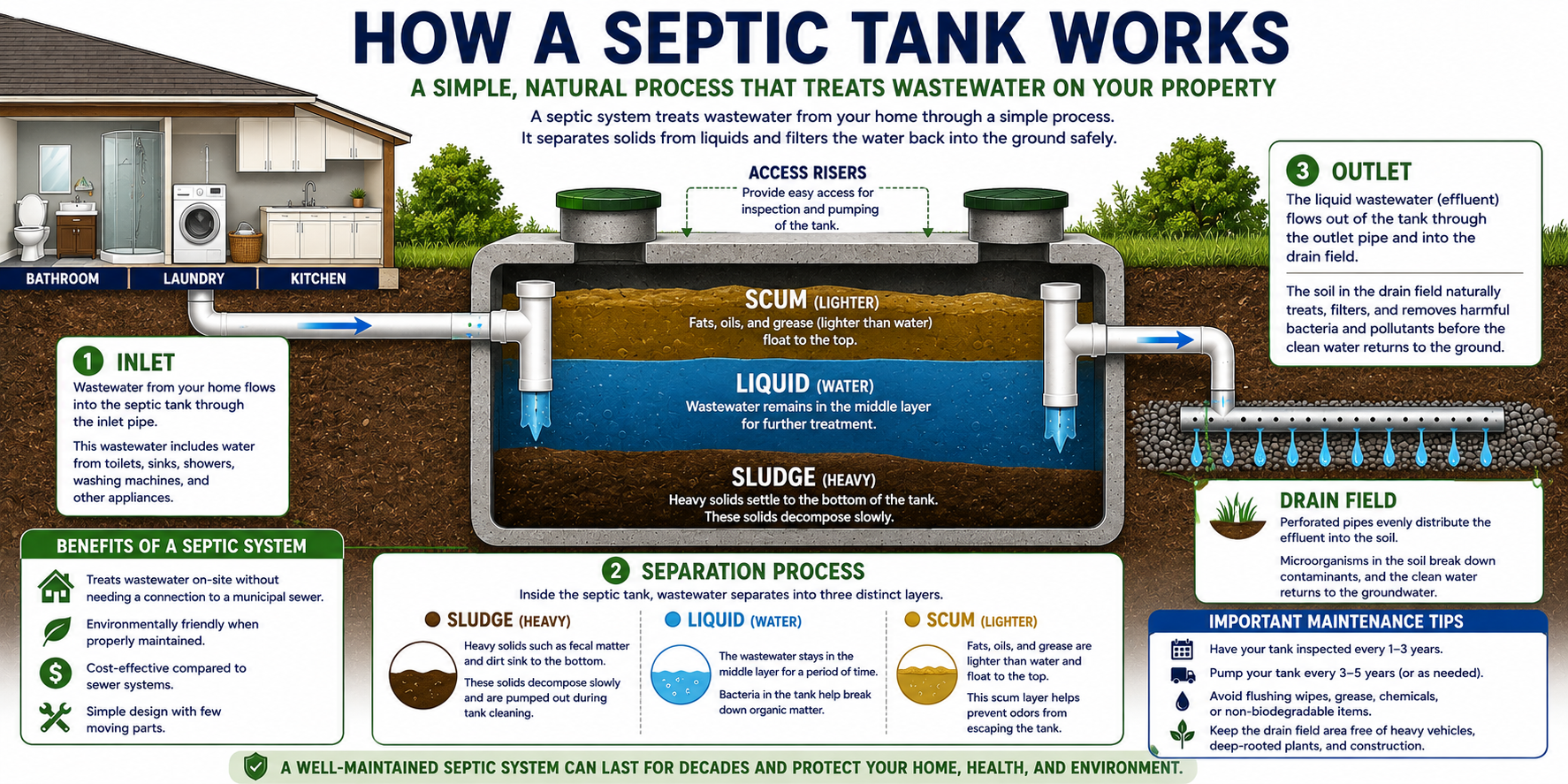
Diagram showing how a septic tank works: wastewater enters through the inlet, separates into scum, liquid, and sludge layers inside the tank, and treated effluent exits through the outlet to the drain field

Step 1: Wastewater Enters the Tank

Everything that goes down a drain in the house — toilets, sinks, showers, washing machine — flows through a single pipe into the buried septic tank, typically a 1,000 to 1,500 gallon concrete, plastic, or fiberglass container.

Step 2: Solids Settle, Grease Floats

Inside the tank, wastewater separates into three layers. Heavier solids sink to the bottom and form a layer of sludge. Fats, oils, and grease float to the top and form a layer of scum. In between sits a layer of relatively clear liquid called effluent.

Step 3: Bacteria Break Down Waste

Naturally occurring anaerobic bacteria inside the tank continuously digest the sludge and scum layers, breaking down organic solids over time. This is the core biological process that makes a septic tank work at all — it’s also exactly what a product like Septifix is designed to support and accelerate.

Step 4: Effluent Moves to the Drain Field

As new wastewater enters the tank, an equivalent volume of clarified effluent exits through an outlet pipe into the drain field — a network of perforated pipes buried in gravel-filled trenches. There, the effluent filters down through the soil, which provides the final stage of natural treatment before water rejoins the groundwater system.

Why this sequence matters for maintenance: Every septic problem ultimately traces back to one of these four steps breaking down — usually because solids build up faster than bacteria can process them, and eventually reach the drain field where they don’t belong.

Types of Septic Systems

  • Conventional (anaerobic) systems — the most common type, relying on naturally occurring bacteria that don’t require oxygen. Generally the least expensive option, though they need a larger drain field
  • Aerobic treatment units (ATUs) — use a pump to introduce oxygen into the tank, activating aerobic bacteria that break down waste more efficiently. More expensive to install and run, but often required on lots with limited space or challenging soil
  • Mound systems — build the drain field up above natural grade using imported fill, used where a high water table, shallow bedrock, or poor soil rules out a conventional in-ground field
  • Alternative and engineered systems — pressure-distribution, sand-filter, and other specialized designs used when site conditions require a customized solution beyond the standard options above

Septic Tank Costs in 2026

ItemTypical Cost (2026)
Conventional (anaerobic) system installation$3,000–$8,000
Aerobic treatment system (ATU) installation$10,000–$20,000
Mound system installation$10,000–$20,000+
Full system replacement (tank + drain field)$6,000–$15,000, national average around $8,000
Routine pumping (1,000–1,500 gal tank)$300–$600, national average around $400–$450
Annual inspection$100–$250
General repairs$165–$6,500, average around $1,830
Drain field replacementAround $7,000
Riser installation$300–$600
Pump replacement (ATU)$800–$1,400

Location, soil conditions, tank accessibility, and how long it’s been since the last pumping all shift these numbers meaningfully — a straightforward install on sandy loam can run under $6,000, while an engineered mound system on clay with a high water table can exceed $18,000. For soil- and region-specific cost breakdowns, see the state guides linked at the end of this article.

The most expensive mistake: Skipping pumping until a tank is already overdue by several years. Hardened, long-neglected sludge takes more time and labor to remove, and by that point, solids have often already reached the drain field — the single most expensive part of the system to replace.

Septic Tank Care: What Actually Matters

  • Pump every 3–5 years — the single most important maintenance task, per EPA guidance. Larger households or higher water use may need more frequent service
  • Only flush toilet paper and human waste — “flushable” wipes, feminine hygiene products, paper towels, and cooking grease don’t break down properly and are one of the leading causes of early system failure
  • Space out heavy water use — running the washing machine, dishwasher, and multiple showers back-to-back can overload the tank’s capacity to separate solids properly
  • Keep the drain field clear — no parking, driving, or planting trees with invasive root systems over the drain field area
  • Know where your tank is — about 63% of homeowners don’t know their tank’s exact location, which adds unnecessary cost and delay when service is needed. Check your property records or the original permit on file with your local health department
  • Support the bacteria doing the work — since bacterial digestion is what breaks down solids between pumpings, avoiding excessive antibacterial soap and harsh chemical drain cleaners helps keep that process functioning as intended

Warning Signs You Shouldn’t Ignore

  • Slow drains throughout the house (not just one fixture)
  • Gurgling sounds in plumbing
  • Sewage odor near the tank or drain field
  • Standing water or unusually lush grass over the drain field
  • Sewage backup into tubs, showers, or toilets — treat this as urgent

Where a Product Like Septifix Fits Into the Picture

Since a septic tank’s core function depends on bacteria continuously breaking down solids, supporting that biological process is one of the most direct ways to extend the time between pumpings and reduce strain on the drain field. Septifix is a monthly tablet treatment formulated with concentrated bacteria and enzymes designed to help break down the sludge layer inside the tank, working alongside — not instead of — regular pumping and sensible water-use habits.

It won’t fix a system that’s already failed, replace a required drain field repair, or substitute for professional service. But as part of a maintenance routine built around the fundamentals above, it’s a straightforward way to support the same natural process your septic system already relies on.

Read the Full Septifix Review →
Affiliate link — we may earn a commission at no extra cost to you

Frequently Asked Questions

How does a septic tank work?
Wastewater from the house flows into the buried tank, where it separates into three layers: sludge (heavier solids) at the bottom, scum (fats, oils, grease) on top, and effluent (relatively clear liquid) in between. Anaerobic bacteria continuously digest the sludge and scum, while clarified effluent exits to the drain field, where soil provides the final stage of treatment before water rejoins the groundwater system.
What are the different types of septic systems?
Conventional (anaerobic) systems are the most common and least expensive, relying on bacteria that don’t need oxygen. Aerobic treatment units (ATUs) use a pump to introduce oxygen for more efficient breakdown, at higher cost. Mound systems raise the drain field above grade for sites with a high water table or shallow bedrock. Alternative and engineered systems, like pressure-distribution or sand-filter designs, are used for challenging site conditions.
How much does a septic system cost in 2026?
A conventional system installation runs $3,000-$8,000, an aerobic treatment system $10,000-$20,000, and a mound system $10,000-$20,000+. Full replacement (tank plus drain field) averages around $8,000 nationally. Routine pumping runs $300-$600, and annual inspection $100-$250.
What should never go into a septic tank?
“Flushable” wipes, feminine hygiene products, paper towels, and cooking grease don’t break down properly and are among the leading causes of early system failure. Only toilet paper and human waste should be flushed.
Explore Region-Specific Guides

Soil type, water table depth, and local regulations all affect how a septic system should be designed and maintained where you live. For a deeper look at your specific region, see the state guides on this site covering Georgia, Florida, California, and Washington.

This article is for general informational purposes and reflects typical septic system design, costs, and maintenance practices as of 2026. Costs vary by region, contractor, and site conditions — always get quotes from licensed local septic professionals. Product results vary by individual system condition and usage.

Is SEPTIFIX a Scam? Honest Review, Evidence, and Buyer’s Guide


Is SEPTIFIX a Scam? Honest Review, Evidence, and Buyer’s Guide

Quick answer: No — SEPTIFIX is not a scam. It’s a monthly septic tank treatment tablet with a real, explainable mechanism (oxygen release plus aerobic bacteria strains that digest waste and cut odor), sold through the official site with a 60-day money-back guarantee. It isn’t a miracle cure and won’t fix a tank that’s already failed or replace pumping — most “scam” complaints trace back to counterfeit resellers, unrealistic overnight expectations, or using it on a system that needed professional repair first.

If you’ve been searching for a solution to septic system issues, you’ve probably come across SEPTIFIX — a septic tank treatment marketed as a way to save homeowners money on pumping and repairs. With that kind of promise comes an obvious question: is it actually legitimate, or too good to be true?

Here’s an honest look at what SEPTIFIX is, how it works, where scam concerns actually come from, and what the evidence supports.

What SEPTIFIX Is and How It Works

SEPTIFIX is a septic tank treatment sold as flushable tablets rather than the liquids or powders most competing brands use. Each tablet is designed to dissolve and release a combination of oxygen and biological compounds that support aerobic bacteria — bacteria that digest organic waste faster than the anaerobic bacteria naturally present in a sealed tank. The mechanism itself (oxygen plus bacteria) isn’t unusual in septic treatment products; SEPTIFIX’s pitch is that the oxygen-release step makes the bacterial activity meaningfully more effective than a bacteria-only formula.

Where the Scam Concerns Actually Come From

“Too good to be true” skepticism is a reasonable default online, especially for a product claiming to reduce pumping costs and eliminate odor. Digging into the actual complaints, they cluster into a few consistent categories rather than pointing to fraud:

  • Unofficial resellers — negative reviews disproportionately trace back to purchases made outside the official site, where counterfeit or expired product is a real risk
  • Overnight-fix expectations — SEPTIFIX is a gradual biological process, not an instant chemical reaction; buyers expecting results in a day or two are often disappointed regardless of whether the product is working as designed
  • Already-failed systems — a tank with a cracked wall, collapsed baffle, or fully failed drain field needs physical repair, not a maintenance tablet, and using SEPTIFIX in that situation won’t produce the results a functioning system would see
The clearest legitimacy signal: a working, honored money-back guarantee. Scam operations generally don’t process refunds reliably — the fact that verified customers report receiving refunds through the official channel is a stronger signal than marketing copy either way.

What SEPTIFIX Can and Can’t Do

What it’s designed to do What it isn’t
Support aerobic bacterial digestion of tank solids A repair for a cracked tank, collapsed baffle, or damaged pipe
Reduce hydrogen sulfide odor at the source An instant, same-day fix
Slow sludge buildup between pump-outs A substitute for pumping altogether
Support a functioning system’s ongoing maintenance A fix for an already-failed drain field

How to Buy It Safely

The official website is the only source that guarantees an authentic product, the 60-day money-back guarantee, and legitimate customer support. Third-party marketplace listings and unfamiliar resale sites aren’t verified — unusually low prices, no visible guarantee, and no contact information are the practical red flags worth checking before you buy anywhere other than the official site.

The Bottom Line

Weighing the actual mechanism, the pattern behind negative reviews, and the money-back guarantee together, SEPTIFIX holds up as a legitimate maintenance product rather than a scam. It works best as one part of a regular maintenance routine on a system that’s otherwise functioning — not as an emergency fix for a tank that’s already in trouble.

Read the Full SEPTIFIX Review →
Affiliate link — we may earn a commission at no extra cost to you

Frequently Asked Questions

Is SEPTIFIX a scam?
No. SEPTIFIX is a legitimate septic tank treatment tablet with a real, explainable mechanism — oxygen-releasing compounds paired with aerobic bacteria strains that digest waste and reduce odor. It’s sold with a 60-day money-back guarantee through the official site. Most scam concerns trace back to unofficial resellers, unrealistic expectations of an overnight fix, or confusing a maintenance product with a repair for a genuinely failed system.
How long does SEPTIFIX take to work?
Many users report noticeable odor reduction within one to three weeks of consistent monthly use. Reducing existing sludge buildup takes longer, typically several weeks to a few months of regular tablets, since it’s a gradual biological process rather than an instant fix.
Can SEPTIFIX replace septic tank pumping?
No. It can reduce how often you need a pump-out by slowing sludge buildup, but it does not eliminate the need for pumping, especially for a tank that’s already overdue or damaged. It’s a maintenance product, not a repair or replacement for physical solids removal.
Where is it safe to buy SEPTIFIX?
The official website is the only source that guarantees an authentic product, the 60-day money-back guarantee, and legitimate customer support. Listings on third-party marketplaces or unfamiliar sites are not verified and carry a real risk of counterfeit or expired stock.

This article reflects general product information and publicly available customer feedback as of 2026; individual results vary by system condition and usage. This post contains affiliate links — if you purchase through a link here, we may earn a commission at no extra cost to you.

Signs Your Septic Tank Is Full: How to Tell Before It’s Too Late


Signs Your Septic Tank Is Full: How to Tell Before It’s Too Late

Infographic listing signs a septic tank is full: slow drains, gurgling noises, unpleasant odors, pooling water, sewage backup, lush green grass, trouble flushing, and time since last pumping

Quick answer: A full septic tank shows up as slow drains across the whole house, gurgling pipes, unpleasant odor indoors or out, pooling water or unusually lush grass over the drain field, trouble flushing toilets, and — in the worst case — sewage backing up into the home. Even without symptoms, it may simply be time: most tanks need pumping every 3-5 years. Any sewage backup indoors should be treated as an emergency.

Most homeowners rarely think about their septic tank until a problem arises. Yet your septic system is one of the most important parts of your home’s infrastructure — it quietly processes waste every day, ensuring your household runs smoothly. However, septic tanks don’t last forever without maintenance. Over time, they fill with solid waste, grease, and sludge that must be pumped out. Ignoring the warning signs can lead to backups, foul odors, costly repairs, and even serious health hazards.

Why Septic Tanks Fill Up

Septic tanks work by separating solids, liquids, and scum. Bacteria inside the tank help break down organic waste, while liquids flow into the drainfield. Over time, solid waste and sludge accumulate at the bottom of the tank. No matter how well your system functions, sludge buildup is inevitable. This is why routine pumping (every 3–5 years for most households) is essential. If pumping is delayed, the sludge and scum layers rise too high, causing blockages and contamination.

1. Slow Drains Throughout the House

One of the first signs your septic tank may be full is slow drainage. If sinks, showers, and tubs are draining sluggishly, it could mean the tank is nearing capacity. Unlike a single clogged pipe, slow drainage across the entire home points to a systemic issue. The tank may not be processing wastewater quickly enough, creating backups in the plumbing system.

2. Gurgling Sounds in the Pipes

If you hear gurgling or bubbling noises when flushing toilets or running water, your septic system may be struggling. These sounds often indicate that air is trapped in the pipes because wastewater is not flowing properly. It can be a clear signal that the tank is too full or that a blockage has formed.

3. Unpleasant Odors Indoors or Outdoors

One of the most obvious and unpleasant signs of a full septic tank is odor. Wastewater that cannot properly flow into the drainfield may seep back into pipes or rise toward the surface. If you notice foul smells around your drains, yard, or near the septic tank area, it’s a strong indication that the system is overwhelmed. Septic odors are not only unpleasant but also a health concern, so they should be addressed immediately.

4. Pooling Water in the Yard

If your septic tank is full, excess wastewater may surface in your yard, especially around the drainfield. This appears as unexplained puddles, soggy soil, or unusually green and lush patches of grass. The drainfield is designed to absorb and filter liquids, but when overloaded, it forces untreated wastewater to the surface. This is a sign of a serious issue that requires professional attention.

5. Sewage Backups in the Home

A sewage backup is one of the worst signs your septic tank is full — and one that homeowners dread. This usually occurs in lower drains, such as basement sinks or first-floor toilets, where wastewater has nowhere else to go. Backups not only damage your home but also expose you and your family to harmful bacteria and pathogens. If you see raw sewage coming up from your drains, it’s an emergency situation that requires immediate septic service.

6. Changes in Lawn Health

Sometimes, the signs of a full septic tank show up in your yard. If patches of grass over the drainfield or septic tank area suddenly become greener and grow faster than the rest of your lawn, it may indicate nutrient-rich wastewater is leaking out. While the grass may look healthier, it’s actually a warning sign that your system is failing to contain waste properly.

7. Trouble Flushing Toilets

If your toilets are slow to flush, require multiple flushes, or frequently clog, your septic tank could be the culprit. A full tank reduces the flow of wastewater, making it harder for toilets to clear completely. This is especially true if multiple toilets in the house are experiencing the same issue at once.

8. High Nitrate Levels in Well Water

For homes with well water, septic tank problems can sometimes be detected through water testing. If nitrate levels in your drinking water are unusually high, it may mean that untreated wastewater from a full or failing septic system is seeping into the groundwater. This poses serious health risks, especially for infants and young children, and should be addressed immediately.

9. Time Since Last Pumping

Even if you haven’t noticed obvious signs, your septic tank may still be full simply because too much time has passed since the last pumping. Most tanks need pumping every 3–5 years, depending on household size and water usage. If it’s been longer than that, scheduling a professional inspection is the safest way to avoid future problems.

What to Do If Your Septic Tank Is Full

  • Call a professional: Septic experts can inspect the system and confirm whether pumping is needed
  • Avoid chemical additives: Harsh chemicals may temporarily mask the problem but harm bacteria and damage the system
  • Conserve water: Reduce water usage until the tank is serviced to prevent further overload
  • Consider treatments: Bacterial boosters such as SEPTIFIX tablets can help maintain balance and reduce odors after pumping

Preventing Future Septic Tank Problems

Prevention is always better than repair. To avoid frequent issues, follow these tips:

  • Schedule regular pumping every 3–5 years
  • Use a monthly septic treatment to support bacteria
  • Never flush wipes, feminine hygiene products, or grease
  • Conserve water with efficient appliances and mindful usage
  • Keep heavy vehicles and deep-rooted trees away from the drainfield
Use SEPTIFIX Tablets to Keep Your Septic Tank Clean →
Affiliate link — we may earn a commission at no extra cost to you

Frequently Asked Questions

What are the most common signs a septic tank is full?
Slow drains throughout the house, gurgling pipes, unpleasant odor indoors or outdoors, pooling water or unusually lush grass over the drain field, and trouble flushing toilets are the most common early signs. Sewage backing up into the home is the most serious, urgent sign.
Why does slow drainage in every sink mean the septic tank is full?
A single slow drain usually points to a local clog in that fixture’s pipe. Slow drainage across the entire house — sinks, showers, and tubs all at once — points to the shared system instead, meaning the tank isn’t processing wastewater quickly enough and is likely near capacity.
Can high nitrate levels in well water indicate a full septic tank?
Yes. For homes on well water, unusually high nitrate levels can indicate that untreated wastewater from a full or failing septic system is seeping into the groundwater. This poses health risks, particularly for infants and young children, and should be investigated promptly.
How often should a septic tank be pumped?
Most households need pumping every 3-5 years, depending on tank size, household size, and water usage. If it’s been longer than that since the last pumping, scheduling a professional inspection is the safest way to check the tank’s condition, even without obvious symptoms.

Final Thoughts

Knowing the signs your septic tank is full can save you from messy, expensive, and dangerous problems. From slow drains and foul odors to sewage backups and pooling water in the yard, these warning signals should never be ignored. Regular pumping, preventative maintenance, and monthly treatments like SEPTIFIX tablets can keep your system balanced, odor-free, and running smoothly for years to come.

If it’s been more than a few years since your last inspection or you notice any of these warning signs, act now. Addressing septic tank issues early is the best way to protect your home, your family, and the environment.

This article is for general informational purposes and isn’t a substitute for a professional inspection. If you’re seeing sewage backup into the home, contact a licensed septic professional immediately. Product results vary by individual system condition and usage. This post contains affiliate links; we may earn a commission if you make a purchase, at no extra cost to you.

Best Septic Tank Treatment: Keep Your System Healthy and Odor-Free


Best Septic Tank Treatment: Keep Your System Healthy and Odor-Free

Infographic comparing three types of septic tank treatments: biological treatments that use bacteria and enzymes to break down organic waste, chemical treatments that contain acids or alkalis and may kill beneficial bacteria, and enzyme-based treatments that help digest fats, oils, and paper and are often used alongside bacteria

Quick answer: The best septic tank treatments are biological — using bacteria and enzymes to break down organic waste — rather than chemical treatments, which rely on acids or alkalis that can kill the beneficial bacteria your tank depends on. Among biological options, SEPTIFIX stands out for its oxygen-release mechanism paired with bacteria; Rid-X and Green Gobbler are also widely used enzyme-and-bacteria options. No treatment replaces pumping — it slows sludge buildup and controls odor, but solids still need to be physically removed every 3-5 years.

Your septic tank is one of the most important parts of your home’s waste management system. Yet, for many homeowners, it’s often out of sight and out of mind until something goes wrong. From foul odors to backed-up drains, septic system issues can be stressful and expensive to fix. That’s why preventative care with the right septic tank treatment is essential. This guide covers what septic tank treatments actually do, the different types available, and which options hold up best for long-term performance.

What Is a Septic Tank Treatment?

A septic tank treatment is a product designed to maintain a healthy balance of bacteria and enzymes inside your tank. These microorganisms break down organic waste, reduce sludge buildup, and minimize odors. The right treatment can keep your system running efficiently and extend its lifespan. Treatments come in various forms, including tablets, powders, liquids, and enzyme packs.

Why Septic Tank Treatments Matter

When a septic system is neglected, waste accumulates faster than bacteria can handle. Over time, this leads to clogged pipes, overflowing tanks, and costly repairs. Treatments provide several benefits:

  • Supports beneficial bacteria: Encourages natural waste digestion inside the tank
  • Reduces odors: Neutralizes unpleasant smells from waste and sludge buildup
  • Prevents clogs: Helps break down paper, grease, and organic matter that could block pipes
  • Protects the environment: Reduces the risk of untreated waste contaminating groundwater
  • Cost savings: Fewer repairs, less frequent pumping, and longer system life

The Three Types of Septic Tank Treatments

1. Biological Treatments

Biological treatments rely on bacteria and enzymes to break down organic waste naturally. These are considered the safest and most effective option because they work with your tank’s ecosystem instead of against it. They are eco-friendly and won’t harm pipes or groundwater.

2. Chemical Treatments

Chemical-based treatments often use acids, alkalis, or harsh cleaners to dissolve clogs or sludge. While they may provide a quick fix, they also kill the beneficial bacteria your system needs to function properly. Long-term use can damage pipes, corrode the tank, and harm the environment.

3. Enzyme-Based Treatments

Enzyme-based formulas use specific proteins to accelerate the breakdown of fats, oils, and paper. While they are helpful, they usually work best when paired with bacterial treatments to ensure a balanced ecosystem inside your septic tank.

What Makes the Best Septic Tank Treatment

When evaluating products, look for these qualities:

  • Non-toxic and eco-friendly: Safe for the environment and groundwater
  • Supports bacterial balance: Should encourage the growth of good bacteria, not kill them
  • Ease of use: Tablets or pouches you can flush are convenient and effective
  • Proven results: Choose products with customer reviews, scientific backing, or certifications
  • Odor control: A good treatment should help reduce foul smells quickly

Top Recommended Septic Tank Treatments

1. SEPTIFIX Tablets — Best Overall Natural Treatment

SEPTIFIX tablets are one of the more distinctive biological septic tank treatments available. Unlike traditional enzyme or bacteria packs, these tablets release oxygen directly into the tank, creating a favorable environment for beneficial bacteria to thrive. They’re formulated to help reduce odors within days, break down sludge, and prevent clogs naturally. Each tablet is septic-safe, eco-friendly, and easy to use — just flush one tablet per month.

  • Designed to neutralize odors within 3–5 days
  • Encourages aerobic bacterial growth via oxygen release
  • Formulated to be safe for pipes, tanks, and the environment
  • Aims to reduce pumping frequency, not eliminate it

2. Rid-X Septic Treatment

Rid-X is one of the most well-known septic products on the market. It combines enzymes and bacteria that help break down household waste. While effective, some homeowners find they need frequent applications for consistent results. Still, it remains a popular choice for those looking for an affordable solution.

3. Green Gobbler Septic Saver

Green Gobbler offers monthly septic tank treatment pods. They are easy to use — just drop one in the toilet and flush. These enzyme-based pods help maintain bacterial balance and reduce buildup. They are eco-friendly and convenient, especially for busy households.

4. Enzyme Packs (Generic Options)

Many brands offer enzyme-only packs that dissolve in water and release enzymes into your septic system. While they don’t contain bacteria, they are useful as a supplement to help break down fats and oils more quickly.

How to Use Septic Tank Treatments Effectively

  • Follow the instructions carefully for dosage and frequency
  • Use treatments consistently — most are monthly or quarterly
  • Avoid flushing harmful chemicals that could undo the treatment’s benefits
  • Pair treatments with good septic habits: conserve water, avoid flushing non-biodegradable items, and pump the tank every 3–5 years

Natural Alternatives to Store-Bought Treatments

If you prefer DIY solutions, some natural options can support your septic system:

  • Baking Soda: Balances pH and keeps bacteria active. Use one cup per week
  • Vinegar: Safe cleaner for drains and toilets that won’t harm bacteria
  • Lemon Juice: Natural degreaser with a fresh scent

While these methods help with maintenance, they may not be as powerful as specialized treatments like SEPTIFIX tablets.

Signs Your Septic Tank Needs Treatment

Not sure if it’s time to start or switch treatments? Look out for these warning signs:

  • Persistent foul odors inside or outside the home
  • Slow drains and frequent clogs
  • Unusually lush grass above the septic tank area
  • Pooling water in the yard
  • Gurgling sounds in pipes

If you notice any of these symptoms, your septic system may be struggling and in need of immediate attention — see the full breakdown in Signs Your Septic Tank Is Full.

Check Current SEPTIFIX Pricing →
Affiliate link — we may earn a commission at no extra cost to you

Frequently Asked Questions

What is the best type of septic tank treatment?
Biological treatments, which use bacteria and enzymes to break down organic waste, are generally considered the best and safest option. Unlike chemical treatments, which can kill the beneficial bacteria a septic system depends on, biological treatments work with the tank’s natural ecosystem instead of against it.
Why should you avoid chemical septic tank treatments?
Chemical treatments often use acids or alkalis to dissolve clogs or sludge quickly, but they also kill the beneficial bacteria the tank needs to function. Long-term use can damage pipes, corrode the tank, and harm the environment, even though the short-term effect looks like a fix.
What should I look for in a septic tank treatment?
Look for a non-toxic, eco-friendly formula that supports bacterial balance rather than killing it, is easy to use consistently (tablets or flushable pouches), has real customer reviews or scientific backing, and delivers noticeable odor control within days.
Can a septic tank treatment replace pumping?
No. Treatments support the tank’s biological process and can slow sludge buildup and reduce odor, but they do not physically remove accumulated solids. Routine pumping every 3-5 years is still required regardless of which treatment you use.

Final Thoughts

Choosing the best septic tank treatment is essential for maintaining a healthy, odor-free, and long-lasting system. Biological solutions are the safest and most effective, with SEPTIFIX tablets standing out as a strong all-around choice. By supporting natural bacteria, reducing odors, and helping prevent sludge buildup, they provide an easy and eco-friendly addition to routine maintenance.

Remember, the best results come from combining regular treatment with good septic habits: conserve water, avoid flushing harmful substances, and schedule routine pumping. With the right approach, your septic tank will serve your household efficiently for many years to come.

This article is for general informational purposes; individual results vary by system condition and usage. This post contains affiliate links — if you purchase through a link here, we may earn a commission at no extra cost to you.

How to Clean a Septic Tank Naturally

How to Clean a Septic Tank Naturally

Infographic on how to clean a septic tank naturally: pump regularly, add probiotic tablets, use household ingredients like baking soda and vinegar, avoid toxic products, and conserve water
Quick answer: Cleaning a septic tank naturally means supporting its bacterial ecosystem instead of fighting it with harsh chemicals. The core habits: pump on schedule (every 3-5 years — no natural method replaces this), use probiotic tablets to keep bacteria strong, rely on septic-safe household ingredients like baking soda and vinegar instead of bleach or ammonia, conserve water so bacteria aren’t diluted, and control what goes down the drain in the first place.

A septic tank is one of the most important parts of any home that isn’t connected to a city sewer system. It works quietly in the background, processing waste and protecting your family’s health. But over time, sludge, grease, and non-biodegradable waste can build up inside the tank. If left unchecked, this buildup can cause blockages, foul odors, expensive repairs, or even full system failure. The good news? You don’t always need harsh chemicals to clean and maintain your septic system. In fact, learning how to clean your septic tank naturally is safer, more affordable, and better for the environment.

Why Choose Natural Septic Tank Cleaning?

Before diving into the “how,” it’s important to understand the “why.” Many chemical additives promise to clean septic tanks quickly. However, these harsh solutions often kill the beneficial bacteria that your septic system needs to break down waste. This creates an imbalance inside the tank, forcing sludge to accumulate faster. In contrast, natural methods support the tank’s microbial balance, extend its lifespan, and reduce the chances of groundwater contamination.

  • Eco-Friendly: Natural cleaning methods avoid toxic runoff that could harm local water supplies
  • Cost-Effective: Household ingredients like vinegar and baking soda are inexpensive and effective
  • Long-Term Protection: By supporting healthy bacteria, natural cleaning keeps your septic system functioning smoothly

1. Pumping: The First Step in Cleaning

While natural methods are excellent for maintenance, no septic tank can go forever without being pumped. Pumping removes solid waste and sludge that even bacteria cannot fully break down. For most households, pumping is necessary every 3–5 years. Think of it as a reset button that prepares your system for the benefits of natural cleaning methods.

2. Harness the Power of Bacteria

The heart of any septic system is its microbial ecosystem. Billions of bacteria inside your tank eat and digest organic waste. To clean and refresh your tank naturally, you need to support this bacterial activity.

Natural septic-safe products such as SEPTIFIX tablets work by releasing oxygen and stimulating the growth of beneficial bacteria. This process breaks down sludge, reduces odor, and prevents blockages. Unlike chemical cleaners, probiotic tablets feed the natural balance of your tank instead of destroying it.

3. Use Household Ingredients

You probably already have septic-safe cleaners in your kitchen. Here are three natural solutions you can use regularly to keep your system fresh:

  • Baking Soda: This versatile powder balances pH levels and prevents the tank from becoming too acidic, which can harm bacteria. Pour 1 cup of baking soda down the drain once a week to maintain a healthy balance
  • White Vinegar: An excellent natural disinfectant, vinegar can clean drains and pipes without harming beneficial bacteria. Mix one part vinegar with one part water to scrub sinks and toilets
  • Lemon Juice: Adds a fresh scent while naturally breaking down grease and grime. Use it in moderation for cleaning kitchen sinks or garbage disposals

4. Avoid Toxic Substances

Cleaning a septic tank naturally isn’t just about what you add — it’s also about what you avoid. Certain chemicals can kill bacteria and make natural cleaning ineffective. Stay away from: bleach-based cleaners, ammonia products, drain cleaners with strong chemicals, and antibacterial soaps (they kill helpful microbes too).

5. Enzyme-Based Additives

Along with bacteria, enzymes play a key role in breaking down organic material inside your tank. Enzyme-based additives accelerate the decomposition of fats, oils, and paper, helping your system stay clean naturally. These additives are safe, effective, and widely available. Use them monthly as part of your maintenance routine.

6. Control What Goes Into the Tank

One of the simplest ways to clean and maintain a septic tank naturally is to prevent problems in the first place. Be mindful of what you flush or pour down the drain. Items that don’t decompose naturally create buildup inside your tank. Avoid flushing:

  • Wipes (even “flushable” ones)
  • Feminine hygiene products
  • Grease and cooking oil
  • Coffee grounds
  • Harsh chemicals

7. Conserve Water

Excessive water entering your septic tank dilutes the natural bacteria and reduces efficiency. By practicing water conservation, you allow your septic system to break down waste more effectively. Try these habits:

  • Install low-flow showerheads and toilets
  • Repair leaky faucets and pipes quickly
  • Space out laundry loads instead of washing everything in one day

8. Maintain the Drainfield

Cleaning your septic tank naturally also involves protecting the drainfield — the area where treated water is released into the soil. Keep it functioning properly by:

  • Not parking vehicles on top of it
  • Directing rainwater away from the area
  • Planting only grass or shallow-rooted plants above it

9. Signs Your Tank Needs Attention

Even with natural cleaning methods, it’s important to recognize when your system is struggling. Common warning signs include:

  • Unpleasant odors in your yard or home
  • Slow drains and frequent backups
  • Gurgling sounds in pipes
  • Wet or spongy ground above the tank

If you notice any of these issues, it’s time to schedule an inspection and consider pumping — see the full breakdown in Signs Your Septic Tank Is Full.

10. Combine Routine Maintenance with Natural Cleaners

No single method is enough on its own. The most effective approach to cleaning your septic tank naturally is combining multiple habits: regular pumping, natural probiotics like SEPTIFIX, enzyme additives, water conservation, and careful waste disposal. When practiced together, these steps ensure your septic system stays clean, balanced, and long-lasting.

Learn More About SEPTIFIX →
Affiliate link — we may earn a commission at no extra cost to you

Frequently Asked Questions

Can you really clean a septic tank naturally?
Yes, in the sense of ongoing maintenance rather than a one-time deep clean. Natural methods — probiotic tablets, baking soda, vinegar, water conservation, and controlling what goes down the drain — support the tank’s bacterial ecosystem instead of killing it the way harsh chemicals do. But natural methods don’t replace pumping, which physically removes solids no bacteria can fully break down.
Why do chemical septic cleaners cause more harm than good?
Many chemical additives promise a quick clean, but harsh solutions like bleach, ammonia, and strong drain cleaners kill the beneficial bacteria the septic system relies on to break down waste. This creates an imbalance inside the tank, causing sludge to accumulate faster rather than slower.
What household ingredients are safe for a septic tank?
Baking soda (about 1 cup down the drain weekly) helps balance tank pH, white vinegar diluted with water is a safe disinfectant for sinks and toilets, and lemon juice in moderation naturally breaks down grease. All three support bacteria rather than killing them, unlike bleach or ammonia-based cleaners.
Does natural septic cleaning replace pumping?
No. Pumping removes solid waste and sludge that bacteria cannot fully break down, and most households still need it every 3-5 years regardless of how well they maintain the tank naturally. Natural methods extend the time between pump-outs and keep the system running smoothly, but they don’t replace physical solids removal.

Final Thoughts

Learning how to clean your septic tank naturally can save you thousands of dollars in repairs while giving you peace of mind. Natural cleaning isn’t just about dumping additives into the tank — it’s about creating an ecosystem where beneficial bacteria thrive, water usage is balanced, and harmful materials are kept out. Whether you’re using baking soda from your pantry, probiotic tablets like SEPTIFIX, or enzyme-based additives, the key is consistency. Regular attention and eco-friendly habits will keep your septic system healthy for years to come.

Remember: prevention is easier than repair. By following natural cleaning methods, you’ll protect your home, your health, and the environment — all while keeping your septic tank in top condition.

This article is for general informational purposes; individual results vary by system condition and usage. This post contains affiliate links — if you purchase through a link here, we may earn a commission at no extra cost to you.