7 Signs Your Septic Tank Needs Pumping

7 Signs Your Septic Tank Needs Pumping

7 Signs Your Septic Tank Needs Pumping

Quick answer: A septic tank never announces it’s full, but it drops hints in this order: slow drains throughout the house, gurgling pipes, odors indoors or out, unusually lush green grass over the drain field, standing water or soggy ground, and finally sewage backing up into the house. A seventh sign is simply going more than 5 years without a pump-out, symptoms or not. Catch it at stage 1-3 and a routine pump-out (~$400-$450) is all you’ll need; wait until 4-6 and you risk drain field damage.

A septic tank never announces that it’s full. It drops hints — quiet ones at first, then progressively louder and smellier ones. Learn to read the early hints and a pump-out is all you’ll ever need. Miss them, and the story can end with sewage in your bathtub and a drain field replacement quote.

Here are the seven signs, ranked roughly in the order they appear.

1. Drains Are Slow — Everywhere

One slow sink is a hair clog. Every drain in the house running sluggish — shower, kitchen, toilets — points to the system they all share. When the tank’s solids build toward the outlet, wastewater has nowhere to go quickly, and the whole house slows down together. This is the earliest and most commonly ignored sign.

2. Gurgling Pipes

Air trapped by rising water levels has to escape somewhere, and it burbles back up through your pipes. If you hear gurgling from the toilet after flushing, or from the shower drain when the washing machine empties, your tank is likely running high.

3. Odours Indoors or Out

A healthy septic system is essentially odour-free. Sewage smells near drains, around the tank lid, or drifting across the garden mean gases are escaping from a tank that’s too full — or digestion inside it has stalled. Either way, it’s time to book the truck. (Persistent odour even after pumping usually points to a weak bacterial colony — more on that below.)

4. Suspiciously Lush Grass Over the Drain Field

If one stripe of your lawn is greener, taller and happier than everywhere else — directly over the drain field — it’s being fertilised from below by effluent that isn’t filtering properly. Ironically, the best-looking grass on the street is one of the clearest signs of septic trouble.

5. Standing Water or Soggy Ground

Puddles or spongy ground near the tank or drain field without recent rain mean the system can no longer absorb what’s being sent to it. At this stage, solids may already be clogging the field’s pipes. Pump now and you may still save it.

6. Sewage Backing Up Into the House

The emergency stage. Wastewater rising in the lowest drains — basement fixtures, ground-floor showers and toilets — means the tank is at capacity and the water has nowhere to go but backwards. Stop using water immediately and call a septic company for same-day service. Yes, emergency callouts cost more; a sewage-flooded bathroom costs far more.

7. It’s Simply Been Too Long

No symptoms at all — but no record of a pump-out in the last five years? Treat that as sign number seven. Tanks can quietly pass the danger point without visible drama while sludge creeps into the drain field. If you’ve just moved in and there’s no paperwork, book a pump-out; it doubles as a full inspection. Your ideal interval depends on tank and household size — check yours in How Often Should You Pump Your Septic Tank?

What To Do If You’re Seeing These Signs

One early sign (1–3): book a routine pump-out in the next week or two. Expect around $400–$450 — full pricing here: Septic Tank Pumping Cost.

Multiple signs or anything from 4–6: call today and mention the symptoms; ask for an inspection while the tank is empty so any baffle or drain field damage is caught early.

Why Tanks Fill Faster Than They Should

Here’s the part most warning-sign articles skip: two identical tanks can fill at wildly different rates. The difference is usually the bacteria inside. Your tank relies on a living colony to digest solids — and modern habits (bleach-heavy cleaning, antibacterial soaps, harsh drain chemicals) steadily kill it off. Weak bacteria means faster sludge build-up, more odours, and warning signs arriving years early.

The fix is twofold: keep the harshest chemicals out of your drains, and consider a monthly biological treatment that restocks the colony. We’ve tested the market leader and written up what it genuinely does and doesn’t do: our full Septifix review.

Read Our Full Septifix Review →
Affiliate link — we may earn a commission at no extra cost to you

Frequently Asked Questions

What are the early warning signs a septic tank needs pumping?
The earliest and most commonly ignored sign is slow drains throughout the whole house, not just one fixture. Gurgling pipes and indoor or outdoor odors follow as the tank fills further. Unusually lush, green grass over the drain field, standing water or soggy ground, and sewage backing up into the house are the later, more serious signs.
Can additives or using less water fix a full septic tank?
No. Cutting water use buys time, but the accumulated sludge is still there and only pumping physically removes it. Additives are for maintenance between pump-outs to slow future buildup — they don’t dissolve a tank’s worth of existing solids.
Why do some septic tanks fill up faster than others?
Two identical tanks can fill at very different rates depending on the health of the bacterial colony inside. Bleach-heavy cleaning, antibacterial soaps, and harsh drain chemicals steadily kill off the bacteria that digest solids, which means weaker bacteria leads to faster sludge buildup, more odor, and warning signs arriving years earlier than they should.
What should I do if sewage is backing up into my house?
This is an emergency. Stop using water in the house immediately and call a septic company for same-day service. Emergency callouts cost more than routine pumping, but far less than repairing a sewage-flooded bathroom.

Costs are general estimates and vary by provider, tank size, and location. Always get a quote from a licensed local septic professional. Product results vary by individual system condition and usage. This post contains affiliate links; we may earn a commission if you make a purchase, at no extra cost to you.

Signs Your Septic Tank Needs Pumping. A septic tank never announces that it’s full. It drops hints — quiet ones at first, then progressively louder and smellier ones. Learn to read the early hints and a pump-out is all you’ll ever need. Miss them, and the story can end with sewage in your bathtub and a drain field replacement quote.

Here are the seven signs, ranked roughly in the order they appear.

1. Drains Are Slow — Everywhere

One slow sink is a hair clog. Every drain in the house running sluggish — shower, kitchen, toilets — points to the system they all share. When the tank’s solids build toward the outlet, wastewater has nowhere to go quickly, and the whole house slows down together. This is the earliest and most commonly ignored sign.

2. Gurgling Pipes

Air trapped by rising water levels has to escape somewhere, and it burbles back up through your pipes. If you hear gurgling from the toilet after flushing, or from the shower drain when the washing machine empties, your tank is likely running high.

3. Odours Indoors or Out

A healthy septic system is essentially odour-free. Sewage smells near drains, around the tank lid, or drifting across the garden mean gases are escaping from a tank that’s too full — or digestion inside it has stalled. Either way, it’s time to book the truck. (Persistent odour even after pumping usually points to a weak bacterial colony — more on that below.)

4. Suspiciously Lush Grass Over the Drain Field

If one stripe of your lawn is greener, taller and happier than everywhere else — directly over the drain field — it’s being fertilised from below by effluent that isn’t filtering properly. Ironically, the best-looking grass on the street is one of the clearest signs of septic trouble.

5. Standing Water or Soggy Ground

Puddles or spongy ground near the tank or drain field without recent rain mean the system can no longer absorb what’s being sent to it. At this stage, solids may already be clogging the field’s pipes. Pump now and you may still save it.

6. Sewage Backing Up Into the House

The emergency stage. Wastewater rising in the lowest drains — basement fixtures, ground-floor showers and toilets — means the tank is at capacity and the water has nowhere to go but backwards. Stop using water immediately and call a septic company for same-day service. Yes, emergency callouts cost more; a sewage-flooded bathroom costs far more.

7. It’s Simply Been Too Long

No symptoms at all — but no record of a pump-out in the last five years? Treat that as sign number seven. Tanks can quietly pass the danger point without visible drama while sludge creeps into the drain field. If you’ve just moved in and there’s no paperwork, book a pump-out; it doubles as a full inspection. Your ideal interval depends on tank and household size — check yours in How Often Should You Pump Your Septic Tank?

What To Do If You’re Seeing These Signs

One early sign (1–3): book a routine pump-out in the next week or two. Expect around $400–$450 — full pricing here: Septic Tank Pumping Cost.

Multiple signs or anything from 4–6: call today and mention the symptoms; ask for an inspection while the tank is empty so any baffle or drain field damage is caught early.

Signs Your Septic Tank Needs Pumping Why Tanks Fill Faster Than They Should

Here’s the part most warning-sign articles skip: two identical tanks can fill at wildly different rates. The difference is usually the bacteria inside. Your tank relies on a living colony to digest solids — and modern habits (bleach-heavy cleaning, antibacterial soaps, harsh drain chemicals) steadily kill it off. Weak bacteria means faster sludge build-up, more odours, and warning signs arriving years early.

The fix is twofold: keep the harshest chemicals out of your drains, and consider a monthly biological treatment that restocks the colony. We’ve tested the market leader and written up what it genuinely does and doesn’t do: our full Septifix review.

Signs Your Septic Tank Needs Pumping FAQ

Can a full tank fix itself if we use less water? No. Cutting water use buys time, but the sludge is still there. Only pumping removes it.

Will additives empty a full tank? No — no product dissolves a tank’s worth of accumulated solids. Additives are for maintenance between pump-outs, not a substitute for one.

How fast do things get worse? Unpredictably. Some systems limp along for months; others go from slow drains to backup in weeks. The cost difference between acting early and late is enormous, so don’t gamble.

The Bottom Line

Slow drains and gurgles are your cheap warnings; soggy lawns and backups are your expensive ones. Respond at stage one, put the next pump-out in your calendar, and keep the bacteria strong so the signs stay away for good.

Read next: The Complete Septic Tank Pumping Guide · How to Reduce Pumping Frequency
How to Reduce Septic Tank Pumping Frequency (Without Wrecking Your System)

How to Reduce Septic Tank Pumping Frequency (Without Wrecking Your System)

How to Reduce Septic Tank Pumping Frequency. Let’s be clear about the goal first: you can’t eliminate septic pumping, and anyone selling you a product that promises you’ll “never pump again” is selling a drain field replacement on layaway.

What you can do is slow the rate at which sludge accumulates — which stretches a 3-year pumping cycle toward 4 or 5, keeps odours away, and protects the drain field that actually determines your system’s lifespan. At roughly $400–$450 per pump-out, every extra year between services is real money.

Here are the eight habits that genuinely move the needle.

1. Protect the Bacteria Doing the Work

This is the big one, so it goes first. Your tank digests waste using a colony of anaerobic bacteria — and the rate they digest is the single biggest factor in how fast sludge builds. Every dose of chlorine bleach, antibacterial soap, quaternary disinfectant and chemical drain cleaner that goes down your pipes kills part of that workforce.

You don’t need to live like it’s 1850 — normal cleaning is fine. But switch the daily-use products: standard soap instead of antibacterial, septic-safe cleaners for routine jobs, and save the bleach for occasional deep cleans rather than every wipe-down.

Many owners go a step further with a monthly biological treatment — tablets that restock the tank with bacteria and oxygen-releasing compounds to keep digestion at full strength. Used properly they slow sludge build-up and kill odours at the source; used as an excuse to skip pumping, they’re a liability. We’ve written an honest, no-hype breakdown of the market leader — what it does, what it can’t do, and who shouldn’t bother: read our full Septifix review.

2. Retire the Garbage Disposal

Nothing loads a septic tank faster. Ground food waste is exactly the kind of solid material that settles as sludge, and heavy disposal use can shorten your pumping interval by half. Compost it or bin it instead — this single change is worth roughly a year between pump-outs for many households.

3. Keep Grease Out Entirely

Fats, oils and grease don’t digest — they float, harden into the scum layer, and eventually creep toward the outlet. Wipe pans with kitchen roll before washing and pour cooled grease into a jar for the bin. Zero exceptions is the rule that works.

4. Ban the “Flushable” Wipe

Wipes don’t break down, full stop — pumpers haul matted ropes of them out of tanks every single day. Same list, same bin: paper towels, cotton pads, hygiene products, dental floss. Toilet paper only. If everyone in the house follows this one rule, your tank fills dramatically slower.

5. Spread Out Your Water Use

Six laundry loads on Saturday sends a flood through the tank, stirring settled solids and pushing them toward the drain field before bacteria have had time to work. Do a load a day instead. The tank works best with steady, gentle flow — think stream, not tsunami.

6. Fix the Drips

A running toilet can leak hundreds of gallons a day into your system — keeping the tank in constant motion, shortening settling time, and flushing partially digested solids outward. One flapper valve costs a few pounds and pays for itself instantly.

7. Install Water-Efficient Fixtures

Low-flow toilets and showerheads cut the total volume passing through the tank, which means longer settling time and better digestion. If you’re replacing fixtures anyway, this is free septic maintenance.

8. Measure Instead of Guessing

At your next pump-out, ask the technician how thick the sludge layer actually was. If the tank was barely a third full of solids, you’ve earned a longer interval; if it was worse than expected, you’ve caught it early. Two measurements give you a personal schedule better than any rule of thumb — full method here: How Often Should You Pump Your Septic Tank?

How to Reduce Septic Tank Pumping Frequency What Doesn’t Work

  • “Never pump again” miracle additives — no product dissolves inorganic solids; they must be physically removed
  • Yeast, buttermilk and other folk remedies — harmless, but they add negligible bacteria compared to what arrives naturally
  • Simply ignoring it — sludge doesn’t stop at the tank; it graduates to the $5,000–$25,000 drain field

If warning signs are already showing — slow drains, gurgles, odours — habits won’t reverse them. Check Signs Your Septic Tank Needs Pumping and book the truck first; start the habits after.

The Bottom Line

Strong bacteria, no grease, no wipes, no disposal, steady water. Those five ideas, applied consistently, are the difference between pumping every 2–3 years and every 4–5 — hundreds of dollars saved each cycle, and a drain field that lasts as long as the house. Start with whichever habit your household is worst at; that’s where the money is.

Part of our septic care series: Septic Tank Pumping Guide · Pumping Costs in 2026 · Complete Guide to Septic Tanks

Septic Tank Pumping: The Complete 2026 Guide

Septic Tank Pumping: The Complete 2026 Guide

Septic Tank Pumping: The Complete 2026 Guide: Septic tank pumping is the one maintenance job that stands between a healthy septic system and a five-figure repair bill. It’s also one of the most misunderstood — homeowners either forget it exists or pay for it more often than they need to.

This guide covers the whole picture: what pumping actually involves, how often your tank really needs it, what you’ll pay in 2026, and the habits that stretch the time between visits.

What Is Septic Tank Pumping?

Septic tank pumping is the professional removal of accumulated sludge, scum and liquid from your septic tank using a vacuum truck. A technician locates the tank, opens the access lid, and pumps the contents out through a large hose for disposal at a licensed treatment facility. A standard residential pump-out takes 30 to 60 minutes.

Your tank’s bacteria digest most organic waste, but not everything. Inorganic solids and slow-to-digest material steadily build a sludge layer at the bottom. Left long enough, that sludge reaches the outlet pipe and escapes into your drain field — and drain fields don’t recover. Pumping resets the clock before that happens.

Pumping vs Cleaning: Know What You’re Buying

The terms get used interchangeably, but there’s a difference worth asking about:

  • Pumping removes liquids, floating scum and settled sludge — a proper pump-out empties the whole tank.
  • Cleaning adds hydro-jetting of the tank walls and floor to remove compacted, hardened sludge, typically costing 15–25% more.

A tank pumped on schedule rarely needs the full clean. A tank neglected for a decade almost always does. When you book, confirm the company evacuates the entire tank — some cut-price operators skim the liquid and leave the sludge, which is the part you’re actually paying to remove.

How Often Should You Pump?

The EPA’s rule of thumb is every 3 to 5 years, but your real schedule depends on tank size and household size. A family of four on a 1,000-gallon tank needs pumping roughly every 3 years; a couple on the same tank can safely stretch toward 5 or 6. A garbage disposal shortens any interval — it can increase the solid load entering the tank by up to half.

We’ve built a full breakdown by tank size and household in our guide: How Often Should You Pump Your Septic Tank?

What Does It Cost in 2026?

The national average sits around $400–$450, with most homeowners paying between roughly $290 and $600. The big price movers:

  • Tank size — a 750-gallon tank can be as little as $250; a 2,000-gallon tank can top $700
  • Access — a buried lid adds $50–$150 in digging time (a one-time riser install fixes this forever)
  • Neglect — tanks left 10+ years develop compacted sludge that takes longer to remove
  • Location — urban and coastal areas run 20–40% above rural rates
  • Timing — emergency and weekend callouts can cost 50–100% more

Full regional and size-by-size breakdown here: Septic Tank Pumping Cost in 2026

What Happens During a Pump-Out (Step by Step)

  1. Locating the tank. From your records, or with a probe if you don’t know where it is (about 6 in 10 homeowners don’t).
  2. Opening the lid. Excavation if it’s buried; seconds if you have a riser.
  3. Measuring the layers. A good technician checks sludge and scum depth first — it tells you whether your pumping interval is right.
  4. Pumping. The vacuum hose removes scum, liquid, then sludge, with backflushing to break up settled solids.
  5. Inspection. With the tank empty, the tech can spot cracks, root intrusion, and baffle damage — cheap to fix now, catastrophic later.
  6. Paperwork. Keep the receipt and any notes; buyers and inspectors will ask when you sell.

Stay curious during the visit. Two minutes of questions — “How thick was the sludge? Is my interval right? Any baffle wear?” — turns a routine pump-out into a health check.

Waiting for Warning Signs Is Waiting Too Long

Slow drains, gurgling toilets, odours, soggy grass over the drain field — these are signs your tank needed pumping months ago, and effluent may already be pushing solids toward the field. Pump on schedule, not on symptoms. If you’re seeing any of them now, read Signs Your Septic Tank Needs Pumping and book a service this week.

Stretching the Time Between Pump-Outs (Legitimately)

You can’t skip pumping, but you can slow the sludge build-up that drives it:

  • Protect your bacteria. Ease off bleach-heavy cleaning and antibacterial soaps — they kill the organisms digesting your waste. Many owners add a monthly biological treatment to keep the colony strong; we’ve reviewed the leading option honestly here: Septifix review.
  • Ditch the garbage disposal habit. Compost or bin food scraps instead.
  • Spread out water use. Big single-day laundry marathons stir the tank and push solids toward the outlet.
  • Keep grease out entirely. It doesn’t digest; it accumulates.

More detail in How to Reduce Septic Pumping Frequency.

FAQ

Can I pump my own septic tank? A handful of states allow it, but you’d need a vacuum truck and a licensed disposal site. Realistically, no.

Does heavy rain affect pumping? Pumpers sometimes delay work in saturated ground — an empty tank in waterlogged soil can shift or even float, especially plastic ones.

Should the tank be refilled after pumping? No need to refill it manually; normal household use refills it within days, and the bacterial colony re-establishes itself from incoming waste.

Is annual pumping better? Usually it’s wasted money — and pumping too often means the tank never maintains a mature bacterial colony. Match the interval to your measured sludge build-up instead.

The Bottom Line

Pumping every 3–5 years, at roughly $400 a visit, works out to around $100–$150 per year — against $5,000–$25,000 for the drain field failure that skipping it eventually causes. Put a recurring reminder in your phone, look after the bacteria doing the daily work, and this is the easiest bill you’ll ever justify.

Part of our septic care series — start with the Complete Guide to Septic Tanks.

Septic Tanks Explained: How They Work, Costs & Care (2026)

Septic Tanks Explained: How They Work, Costs & Care (2026)

Quick answer: Roughly one in five U.S. households uses a septic system instead of municipal sewer. Wastewater flows into a buried tank and separates into sludge, scum, and effluent; bacteria digest the solids while clarified effluent moves out to a drain field for final soil-based treatment. A conventional system costs $3,000-$8,000 to install, with aerobic and mound systems running $10,000-$20,000+. The single most important maintenance task is pumping every 3-5 years — skipping it is the most common route to a $5,000-$25,000+ drain field failure.

Roughly one in five U.S. households relies on a septic system rather than a municipal sewer connection — yet most homeowners never think about theirs until something goes wrong. This guide covers the basics every septic owner should know: how the system actually works, what it costs to install, repair, and maintain in 2026, and the care habits that keep a system running for decades instead of years.

How a Septic Tank Actually Works

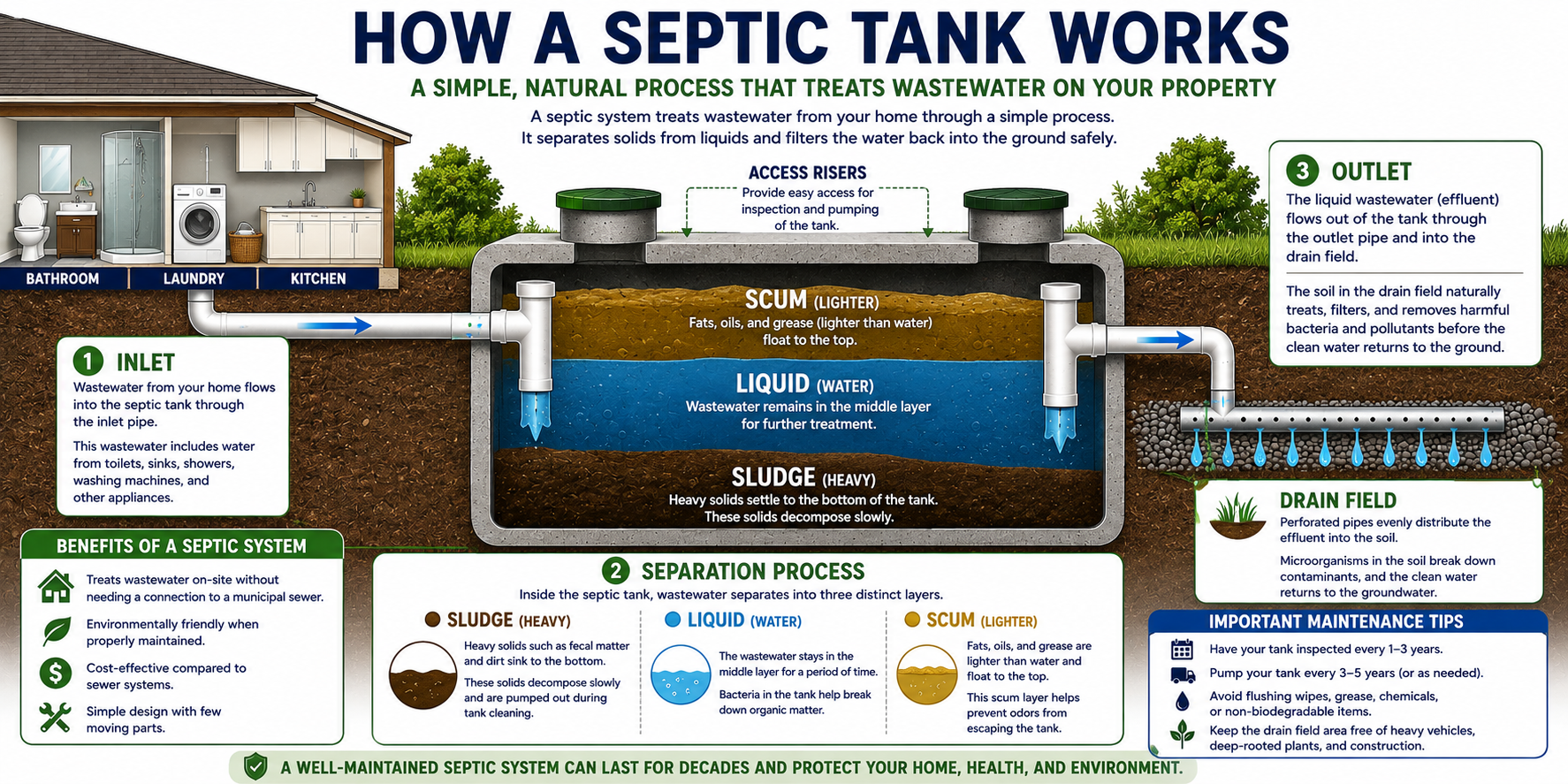
A septic system has two main parts working together: the tank and the drain field (also called a leach field). Understanding what happens at each stage makes the maintenance advice later in this guide make a lot more sense.

Diagram showing how a septic tank works: wastewater enters through the inlet, separates into scum, liquid, and sludge layers inside the tank, and treated effluent exits through the outlet to the drain field

Step 1: Wastewater Enters the Tank

Everything that goes down a drain in the house — toilets, sinks, showers, washing machine — flows through a single pipe into the buried septic tank, typically a 1,000 to 1,500 gallon concrete, plastic, or fiberglass container.

Step 2: Solids Settle, Grease Floats

Inside the tank, wastewater separates into three layers. Heavier solids sink to the bottom and form a layer of sludge. Fats, oils, and grease float to the top and form a layer of scum. In between sits a layer of relatively clear liquid called effluent.

Step 3: Bacteria Break Down Waste

Naturally occurring anaerobic bacteria inside the tank continuously digest the sludge and scum layers, breaking down organic solids over time. This is the core biological process that makes a septic tank work at all — it’s also exactly what a product like Septifix is designed to support and accelerate.

Step 4: Effluent Moves to the Drain Field

As new wastewater enters the tank, an equivalent volume of clarified effluent exits through an outlet pipe into the drain field — a network of perforated pipes buried in gravel-filled trenches. There, the effluent filters down through the soil, which provides the final stage of natural treatment before water rejoins the groundwater system.

Why this sequence matters for maintenance: Every septic problem ultimately traces back to one of these four steps breaking down — usually because solids build up faster than bacteria can process them, and eventually reach the drain field where they don’t belong.

Types of Septic Systems

  • Conventional (anaerobic) systems — the most common type, relying on naturally occurring bacteria that don’t require oxygen. Generally the least expensive option, though they need a larger drain field
  • Aerobic treatment units (ATUs) — use a pump to introduce oxygen into the tank, activating aerobic bacteria that break down waste more efficiently. More expensive to install and run, but often required on lots with limited space or challenging soil
  • Mound systems — build the drain field up above natural grade using imported fill, used where a high water table, shallow bedrock, or poor soil rules out a conventional in-ground field
  • Alternative and engineered systems — pressure-distribution, sand-filter, and other specialized designs used when site conditions require a customized solution beyond the standard options above

Septic Tank Costs in 2026

ItemTypical Cost (2026)
Conventional (anaerobic) system installation$3,000–$8,000
Aerobic treatment system (ATU) installation$10,000–$20,000
Mound system installation$10,000–$20,000+
Full system replacement (tank + drain field)$6,000–$15,000, national average around $8,000
Routine pumping (1,000–1,500 gal tank)$300–$600, national average around $400–$450
Annual inspection$100–$250
General repairs$165–$6,500, average around $1,830
Drain field replacementAround $7,000
Riser installation$300–$600
Pump replacement (ATU)$800–$1,400

Location, soil conditions, tank accessibility, and how long it’s been since the last pumping all shift these numbers meaningfully — a straightforward install on sandy loam can run under $6,000, while an engineered mound system on clay with a high water table can exceed $18,000. For soil- and region-specific cost breakdowns, see the state guides linked at the end of this article.

The most expensive mistake: Skipping pumping until a tank is already overdue by several years. Hardened, long-neglected sludge takes more time and labor to remove, and by that point, solids have often already reached the drain field — the single most expensive part of the system to replace.

Septic Tank Care: What Actually Matters

  • Pump every 3–5 years — the single most important maintenance task, per EPA guidance. Larger households or higher water use may need more frequent service
  • Only flush toilet paper and human waste — “flushable” wipes, feminine hygiene products, paper towels, and cooking grease don’t break down properly and are one of the leading causes of early system failure
  • Space out heavy water use — running the washing machine, dishwasher, and multiple showers back-to-back can overload the tank’s capacity to separate solids properly
  • Keep the drain field clear — no parking, driving, or planting trees with invasive root systems over the drain field area
  • Know where your tank is — about 63% of homeowners don’t know their tank’s exact location, which adds unnecessary cost and delay when service is needed. Check your property records or the original permit on file with your local health department
  • Support the bacteria doing the work — since bacterial digestion is what breaks down solids between pumpings, avoiding excessive antibacterial soap and harsh chemical drain cleaners helps keep that process functioning as intended

Warning Signs You Shouldn’t Ignore

  • Slow drains throughout the house (not just one fixture)
  • Gurgling sounds in plumbing
  • Sewage odor near the tank or drain field
  • Standing water or unusually lush grass over the drain field
  • Sewage backup into tubs, showers, or toilets — treat this as urgent

Where a Product Like Septifix Fits Into the Picture

Since a septic tank’s core function depends on bacteria continuously breaking down solids, supporting that biological process is one of the most direct ways to extend the time between pumpings and reduce strain on the drain field. Septifix is a monthly tablet treatment formulated with concentrated bacteria and enzymes designed to help break down the sludge layer inside the tank, working alongside — not instead of — regular pumping and sensible water-use habits.

It won’t fix a system that’s already failed, replace a required drain field repair, or substitute for professional service. But as part of a maintenance routine built around the fundamentals above, it’s a straightforward way to support the same natural process your septic system already relies on.

Read the Full Septifix Review →
Affiliate link — we may earn a commission at no extra cost to you

Frequently Asked Questions

How does a septic tank work?
Wastewater from the house flows into the buried tank, where it separates into three layers: sludge (heavier solids) at the bottom, scum (fats, oils, grease) on top, and effluent (relatively clear liquid) in between. Anaerobic bacteria continuously digest the sludge and scum, while clarified effluent exits to the drain field, where soil provides the final stage of treatment before water rejoins the groundwater system.
What are the different types of septic systems?
Conventional (anaerobic) systems are the most common and least expensive, relying on bacteria that don’t need oxygen. Aerobic treatment units (ATUs) use a pump to introduce oxygen for more efficient breakdown, at higher cost. Mound systems raise the drain field above grade for sites with a high water table or shallow bedrock. Alternative and engineered systems, like pressure-distribution or sand-filter designs, are used for challenging site conditions.
How much does a septic system cost in 2026?
A conventional system installation runs $3,000-$8,000, an aerobic treatment system $10,000-$20,000, and a mound system $10,000-$20,000+. Full replacement (tank plus drain field) averages around $8,000 nationally. Routine pumping runs $300-$600, and annual inspection $100-$250.
What should never go into a septic tank?
“Flushable” wipes, feminine hygiene products, paper towels, and cooking grease don’t break down properly and are among the leading causes of early system failure. Only toilet paper and human waste should be flushed.
Explore Region-Specific Guides

Soil type, water table depth, and local regulations all affect how a septic system should be designed and maintained where you live. For a deeper look at your specific region, see the state guides on this site covering Georgia, Florida, California, and Washington.

This article is for general informational purposes and reflects typical septic system design, costs, and maintenance practices as of 2026. Costs vary by region, contractor, and site conditions — always get quotes from licensed local septic professionals. Product results vary by individual system condition and usage.